
I’m still a Eurosceptic – a doubter, that is, rather than an opponent; as I try to be about more or less everything. (I’m an academic, after all.) The word is often used misleadingly, which is what makes it difficult for the simple-minded press to get Jeremy Corbyn right: ‘is he for or against?’ You don’t need to be either, and shouldn’t be accused of ‘vacillating’ if you stand somewhere in between. In the present debate I’m strongly on the side of those who want Britain to remain in the European Union; but having done so, I’d still want to see the EU reformed. There’s plenty of material to build on here within the EU, especially on the political Left. A ‘hard’ Brexit would almost certainly scupper all Leftward hopes for a Britain standing alone. That’s one of the reasons why the rich leaders of the Brexit side want it: in order to keep their ill-gotten gains – especially their tax havens – safe from Brussels (that is, ‘socialist’) ‘bureaucracy’. I imagine that this, or something like it, is why Jeremy Corbyn (a) campaigned for Remain in 2016, but (b) is also willing to consider a Brexit that keeps us close to the EU in most ways that matter. Especially if it helps to douse the flickering flames of social and political unrest whipped up by the popular press amongst the grossly misled ‘left behind’ in Britain for all those years.
Nothing, however, has boosted my Europhile (that should really be EU-phile) feelings more than the calm, dignified and reasonable way the EU bigwigs have responded to the very rigid and hostile positions taken up by Britain, and by Theresa May in particular, over the last few months of what are loosely called ‘negotiations’. In particular, I’m greatly taken by Donald Tusk’s latest suggestion, that the brief extension of the process that May has been forced to seek (remember that we were supposed to be coming out of the EU last Friday) be lengthened to about a year; which is surely needed in order to enable whichever government is in power in Britain to properly consider and debate the options realistically available to them. A year would also give time for (a) a new ‘people’s vote’ on whatever they come up with, based of course on today’s electorate, not a three-year old one, and with ‘Remain’ being the other option; and (b) an official enquiry into the illegal (not to say immoral) practices that lay behind the ‘Leave’ vote in June 2016, which are already well documented; and which might – you never know – influence that new vote. (Or not. I wouldn’t be at all confident of the outcome of a second referendum, but I would be more likely to accept it than the first.)
Of course this is why the Brexiteers are so much against an extension. They feel that time may be running out for them. That huge million-strong pro-Europe march in London, and the six million who signed a petition calling for a stop to the Brexit process, may be signs that enthusiasm, at any rate, is amassing on the other side of the argument, even if we can’t be sure that the numbers are.
In the meantime, of course, our stock as a nation is collapsing. Nearly everyone on the European continent has lost all respect for us; or – as I’m finding in Sweden – is sorry for us, which is even less dignified. How do the Brexit ‘patriots’ regard this? Perhaps like Millwall FC fans: ‘Nobody likes us and we don’t care’. There’s something Roman and stoical about this. Kipling put it well, in imperial times. ‘Take up the white man’s burden,/And reap his old reward: / The blame of those ye better, / The hate of those ye guard…’ I associate it with skinhead anarchism. I.e., Millwall FC.
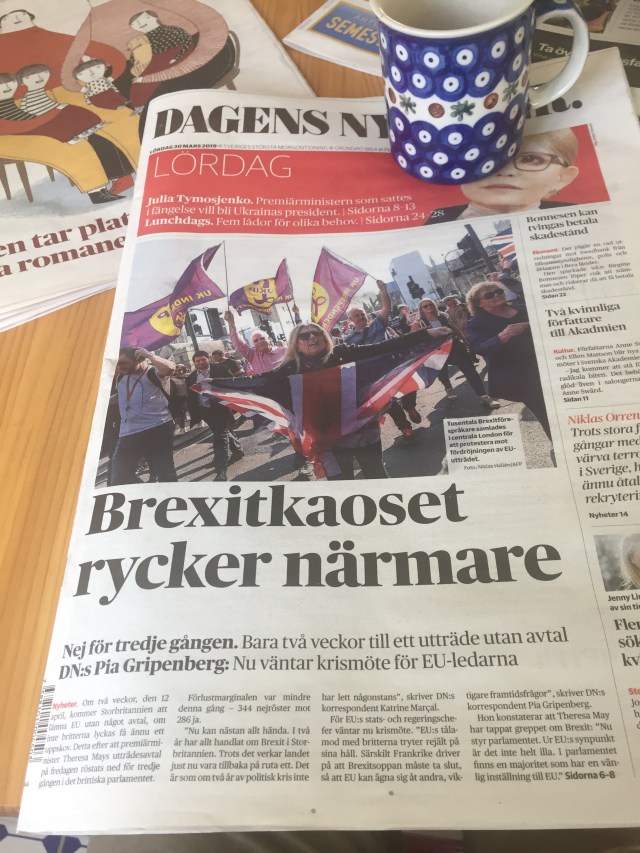
 Porter’s Pensées
Regards, Alex. p.s. I am considering legal action!