Rhodes Must Stay

As a long-established historian of British imperialism – not ‘Establishment’, I hope, and not an ‘imperial historian’, which could imply that I’m an imperialist– I’ve felt nagged over these last few days with the idea that I ought, out of civic duty, to contribute to the current debate (though it’s not a new one) that has sprung out of the killing of George Floyd in Minneapolis, nurtured by the ‘Black Lives Matter’ movement, and has now spread to embrace the question of whether statues of slave-traders and ‘imperialists’ in our British streets should be torn down.

On that last question I have to say I have strong opinions, which might seem at first sight to put me in the camp of the neo-Fascists who are happy to have these men – so far they’re all men – memorialised.

But my argument is very different from theirs. It’s essentially a historian’s argument. These men and what they stood for, however vile, were important in the history of modern Britain, and so should not be forgotten. Indeed, the more reminders there are in our cities of these dreadful aspects of our past national life, the better. All I would ask is that the plaques and inscriptions which in most cases adorn them be radically and prominently modified to recount their crimes, as well as their acts of ‘generosity’ to their local communities. That would put our true – rather than a sanitised – national history on display.

Otherwise we’re faced with the prospect of walking round cities like Bristol and London warmly cushioned by images of just the ‘goodies’ in our national story (if we can even agree on who those were), and oblivious of the rest. I can see that appealing to Right-wing patriots; who should therefore in logic be the ones in favour of bringing down Colston and Rhodes. But not the rest of us.

There’s one more thing that bugs me, as a historian of Empire, about the current ‘pull the statues down’ movement. That is the way its champions misuse the word ‘imperialism’ as a simple synonym for slavery, racism and oppression, when the phenomenon was in fact far more complicated than that; not necessarily ‘better’ – I’m not concerned with moral judgments here – but worthy of more sophisticated analysis. Some of that would allow the real dynamic of imperialism, its motives and its effects, to be understood in ways that should allow us to understand it better, and to target our criticism – if that’s what we want – more precisely and effectively.

I may devote a future post to this. In the meantime, if you can’t wait, and can afford the £15 that Amazon (those great imperialists!) are asking for it, can I recommend my British Imperial: What the Empire Wasn’t (IB Tauris, 2016). It also has a nice picture of me on the fly-leaf.

Posted in Uncategorized | 3 Comments

Who Killed Olof Palme?

This has just gone up on the LRB Blog; a joint effort by Kajsa and me. I thought I might as well share it here.

Well, that was a disappointment. For the last couple of weeks, Swedes have been waiting for the results of a new police inquiry into the assassination of Olof Palme in a side street in Stockholm 34 years ago. Even by the standards of political assassinations, Palme’s murder has been more puzzling than most, and more controversial.

The controversy has been fuelled by his outspoken stances on the Vietnam War, South African apartheid and political brutality generally. He was also a democratic socialist, on roughly the same point on the scale as Jeremy Corbyn. This lay at the root of his enormous popularity in Sweden, and of his government’s considerable social achievements, including legislation on abortion rights, workers’ rights, universal daycare and gender equality. It also however provoked extreme hostility towards him in Sweden from the usual right-wing suspects, to add to his international enemies; some of it expressly anti-semitic (he wasn’t Jewish, but some of the haters thought he was). Since the murder, ‘conspiracy theorists’ – using that term in its broadest sense, to describe anyone who believes that forces behind the scenes can affect politics – have had a field day. The results of the new inquiry, released today, should have brought closure.

They won’t have done. The virtual press conference, streamed live on Swedish TV this morning, conceded that the original police investigation had been flawed. (It isn’t the only one.) Of course the police had a difficult time of it; they apparently interviewed 90,000 people, 134 of whom had confessed to the murder. They narrowed these down to a more manageable number of suspects, including a Kurdish exile group, before finally alighting on a petty criminal called Christer Pettersson, mainly on the strength of an identification by Palme’s widow, Lisbet. Pettersson was convicted but later exonerated and released from prison. He died in 2004.

Today’s report replaces him in the frame with a man called Stig Engström, but not conclusively. Engström had been one of the popular suspects all along, known as ‘Skandia Man’ because he worked for Skandia Insurance, just around the corner from the crime scene. He was on the spot at the time, and afterwards clearly enjoyed his celebrity as a ‘witness’, spreading stories about the murder that turned out to be obvious lies. The evidence against him was all circumstantial: his membership of a shooting club, his alleged hatred of Palme. The police tried to connect the murder weapon with him forensically, but couldn’t. The leader of the inquiry said they reckoned they had enough to commit him for trial, but not to prove his guilt. That could only be done in court but, since Engström had committed suicide in 2000, it was no longer an option. So they’ve closed the book on him, and on the whole affair.

The explanation didn’t entirely satisfy the journalists at the press conference; only one of them, however, raised the question of Engström’s possible motive, and possible links with – for example – South African intelligence services or the CIA. If the police did follow these lines of inquiry, they’re not saying where they led. Indeed, the impression given at the press conference was that the new inquiry only went over the old ground. The report itself and its evidence will not be published in full, on grounds of ‘confidentiality’.

Sweden at the time of the murder was not geared up for this kind of thing. It’s a remarkable fact that Palme and Lisbet were out walking on their own, heading home from a public cinema to their small flat, without the sort of protection afforded to political leaders in every other part of the world. It’s different now. That’s a shame.

So, of course, is the loss of a European leader who meant so much for progressive forces worldwide. Why is it so often the goodies who get gunned down? Maybe a deeper inquiry into the context and motivation behind Palme’s death could have suggested an answer to that.

Posted in Uncategorized | Leave a comment

Marx as a Middle-Order Batsman

Unknown-4Unknown-3I’m a bit of a fan of ‘alternative’ history. There’s nothing wrong with that. All historians need to speculate about ‘what might have happened if’ history had turned out differently, in order to understand why what actually happened did. For me it started with a novel I read ages ago set in a modern Britain (and world) where the Reformation hadn’t taken place; no, not Kingsley Amis’s The Alteration, though that was quite funny – Harold Wilson as a Cardinal, for example – but another, earlier one entirely. It had a steam-driven car on the front cover. (Catholic theology had banned the internal combustion engine.) Can anybody remember? It was more serious than the Amis. More recently I’ve been devouring all those books predicated on the Nazis winning the War – Robert Harris’s Fatherland, for example. And then of course there are similar fables written about an ‘alternative’ USA. I have to say that none of these fictions seems anywhere near as unlikely as what we have in both the UK and the USA just now. I sometimes think that we’re actually living in a speculative novelist’s ‘alternative history’. No-one would have believed in a Trump or a Johnson if a novelist had invented them. Reality should be more normal than this.

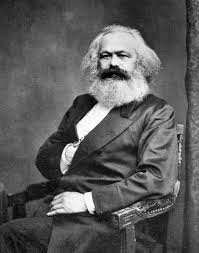
I mention it because for years now I’ve toyed with the idea of writing a ‘What If’ novel myself. It wouldn’t be at all serious, and therefore of any use to historians, but I thought it might be fun. It arises out of the research I used to do into the early London Metropolitan Police Special (or political) Branch; and out of one particular police report I discovered in the course of that. It was penned by an officer whose job it was keep a watch on Karl (or Charles) Marx, the famous London resident. The officer reported back  that Marx was showing no sign of plotting against anyone or anything, so that he could be safely left alone.

Jolly good. It was reassuring to know that our boys in blue were guarding the interests of Britain so resolutely, so that the late Victorians had nothing to fear. Except  that the date didn’t fit. When this report was written, Marx had been dead for three years. Which suggested three possibilities.

The first one was that the Special Branch was a bunch of idiots; which would be entirely consistent with its other activities at this time. (See my The Origins of the Vigilant State, 1987.) The second was that they were somewhat over-zealous, and fearful lest Karl might be resurrected, emerge from his grave in Highgate Cemetery, and resume his fearful career as scourge of the capitalist class. I imagined our portly policeman sitting in a deckchair by his grave, a bottle of Alsopp’s pale ale by his side, keeping an eye open for any sign of the topsoil being disturbed from beneath.

Or – thirdly – did the Special Branch know something we don’t? Maybe Marx faked his own death, adopted a clever disguise, and then, sick of all that writing and plotting, lived his final years in pursuit of another career? That’s the scenario on which my ‘alternative history novel’ would be based.

Then, I admit, it gets a bit silly. Here I was influenced by the career of one of Marx’s followers, the socialist Henry Hyndman, who founded the first genuine British ‘Marxist’ party, the Social Democratic Federation, or SDF; but who before that had been – of all things – a county cricketer. (He’s in Wisden: played in the 1860s for Cambridge University and Sussex, right-hand middle-order batsman, highest score 64, average 16.26.) Hyndman was converted to communism by reading Marx; but what if the conversion had also gone the other way? And then I looked at who else was playing county cricket at that time, and especially at their beards; which of course led me on to the most famous late-Victorian cricketer of them all, WG Grace, whose beard was as spectacular as Karl’s was. All Marx had to do was to trim his differently – longer, less at the sides – and it would amply disguise any other differences in their physiognomies. Then – after getting rid of WG’s body, and a bit of coaching from Hyndman – he could concentrate on making centuries for Gloucestershire, while maybe doing just a little dialectical materialism – to keep his hand in – when he wasn’t actually at the crease.

But sadly, it doesn’t work age-wise. Marx was thirty years older than Grace. In 1883, when he would have taken over from the genuine WG, he was 65. Cricketers  played for longer then than they do now, but not into their 70s. Which is why I’ve abandoned my ‘alternative history’ project. That’s a shame, as I have the Police and Cricket history at my finger-tips. Perhaps I can find another plot to make use of these skills. WG Grace as Jack the Ripper, perhaps? He was a doctor, after all…

Well, it’s a change from genuine history. Facts can be so boring, Ask any postmodernist.

Posted in Uncategorized | 2 Comments

Mob Rule

There’s one powerful argument in favour of the forcible toppling of the 17th century merchant Edward Colston’s statue in Bristol yesterday: which is that he was a vile slave-trader who did not merit being memorialised in this way. I must admit that I personally felt some satisfaction on seeing (on TV) his effigy being tipped into Bristol harbour, whence many of his slave-ships had sailed, literally crammed with Africans for sale in the New World, many of whom died and were unceremoniously dumped in the Atlantic before they got there; to the lasting shame of those responsible at the time, and arguably of their descendants too. (One direct descendant has written on Facebook to say that he was not at all unhappy to see his ancestor treated in this way. Good for him.)

But there are also two equally powerful arguments against. The first is historical. If we remove the visual and public evidence of men like this, we also delete them, and their sins, and the nation’s sins, from history. So people walking around the streets of Bristol (or Oxford, where of course the Rhodes statue outside Oriel College was recently the target of a similar movement to remove it) will no longer be reminded of the dark underside of British history, which must be undesirable. Only memorialising ‘good and great’ people can encourage a rose-tinted and falsely patriotic sense of history, which – as we can see today in the case of Boris Johnson, and all his Brexit nonsense – is illusory and can be highly damaging.

What was wrong about the Colston statue was the inscription on its base, which made no mention of the ‘commodity’ he dealt in as a shipowner, but only of his generosity to the city. Apparently that has been controversial for some time, with efforts being made to change the inscription getting nowhere. But that would have been preferable to moving him out of sight and out of mind. Either that, or stick him in a museum. But publicly memorialising him as a villain would be better.

The second argument against pulling down his statue is the ammunition that gives to the Right. I watched the long Commons debate on the incident this afternoon: one Tory MP after another attacking the ‘mob rule’ of the ‘Black Lives Matter’ movement, with only a few token – and probably insincere – mentions of the racism it was protesting against. The ‘law and order’ Home Secretary, Priti Patel, was obviously relishing it. And so the antics of a few hotheads effectively obscured the more important issue; as they so often do.

Posted in Uncategorized | 2 Comments

The Crucifixion of Jeremy

I’m sorry, but I still hold a candle for Jeremy Corbyn. Here’s an excellent recent piece, penned by two journalists who certainly can’t be dismissed as ‘Corbynistas’, on the scurrilous campaign that was waged against him.

https://www.middleeasteye.net/opinion/killing-jeremy-corbyn

Of course he was unequal to the forces ranged against him. I’m now prepared, out of loyalty to the Labour cause, to go along with Keir, who is probably more politically astute. (I see that he’s already given in to the ultra-Zionists.) But I’m not going to abandon Jeremy, in my heart, just because he was crucified.

Posted in Uncategorized | Leave a comment

Brexit and Coronavirus

Of course we’re not at the end of it yet; but already it has to be accepted that Britain’s response to the coronavirus pandemic is one of the most incompetent and disastrous of any nation’s, resulting in many thousands of unnecessary deaths, mostly the direct and criminal fault of our government. Why is this? Does ideology come into it: the neoliberal-cum-Malthusian idea that the plague should be accepted – ‘taken on the chin’ in Boris Johnson’s words – in order to weed the unfit out of the population, so making the country more efficient? Is this what’s meant by ‘herd immunity’? Or is it simply because we have a government of fools?

If it’s the latter, then the mess that Brexit made of our politics must shoulder much of the blame. Patrick Cockburn of the Independent explains the connexion here.

https://www.independent.co.uk/voices/coronavirus-lockdown-government-death-toll-boris-johnson-a9551516.html.

So, another unwanted effect of that disastrous decision in June 2016. How are the mighty – or at least the haughty – fallen!

Posted in Uncategorized | Leave a comment

Top of the World, Ma!

I watched this press conference live on TV this morning.

https://www.independent.co.uk/news/uk/politics/brexit-barnier-eu-uk-trade-talks-boris-johnson-latest-a9550691.html?utm_medium=Social&utm_source=Facebook&fbclid=IwAR23QXq17irrpYxc6gWIhusqE7_m6VzeOn8TJ055wwDs_AkkmSNZxB4rBSo#Echobox=1591356993.

Barnier is listing all Johnson’s broken pledges to the EU over the last few months. Comparing him to our politicians – Boris and his pathetic Brexit trusties – made me want to weep, and to long for the (general) good sense of European bureaucrats again. It recalled to me what my ex-student, a retiring MP, told me was the opinion of many of his fellow Tories late last year: ‘Boris will always let you down’. Utterly unprincipled, vacuous, a mediocre author and worse historian, a disreputable journalist, a bumbling and incoherent speaker, and on his way to becoming the worst prime minister Britain has ever had – all in all what Shakespeare would have called a ‘scurvy knave’ – he’s almost as disastrous for us Brits as Trump has been for our cousins over the water. It’s almost as if Falstaff – the scurviest knave in all Shakespeare’s corpus – became king. Already Boris has managed – though not alone, I grant you – to push our Coronavirus mortality figures to the top of the international scale. For someone who’s always boasting about how he wants Britain to ‘lead the world’ in just about everything, that must be disquieting.

Or does he actually take pride in it? – I’m reminded of the Jimmy Cagney figure in White Heat, cornered on the roof of a blazing refinery, shouting ‘Top of the World, Ma!’ as he burns. After the present crisis is over, and when we’ve worked out what will follow it (socialism? Fascism?), we’ll need to do some serious thinking on what it is about our ‘democratic’ systems in both countries that can propel such ludicrously unfit men to the top. Poor political education? First past the post? The power of money? The historical imperatives of late capitalism? The media? The continued domination of the Public schools (here)? Pure chance? Or is it some intrinsic flaw in the ideal of ‘democracy’, and consequently – because this follows – in ‘the people’? After all, in Shakespeares’s time the groundlings adored Falstaff .

Posted in Uncategorized | 3 Comments

Short Cuts to My Thoughts

I get a number of these: emails from school students hoping – in effect – that I’ll write their essays for them. I imagine she’s contacted other historians too.

Doesn’t it occur to them that we might have expressed our ‘opinions and ideas’ in books? Or are requests like this intended to relieve them of the necessity of reading? I’ve written back kindly, simply recommending the latest and shortest of my own works on British imperialism. Let’s hope she knows what a ‘book’ is.

I don’t mind, incidentally, specific questions that have occurred to students after  they’ve done a bit of work on the subject. But this is different.

Good evening,

I am currently in Y12 and am starting to think of coursework ideas and am thinking of doing it on the British Empire, I saw you were a historian who specialises in this area and was wondering what your thoughts were. I was thinking of doing it on what factors affected the growth and decline of the British Empire in the 19th century (1800s) and would love to hear your opinion and ideas.

I appreciate in these difficult times you may not be able to get back to me but I would love to hear your views

Thank you for taking the time to read this email and I hope to hear from you in the near future,

Many thanks, ********

Posted in Uncategorized | 2 Comments

Walking Slow Behind You

When I first published books I used to eagerly check all the papers for reviews of them, usually taking hours to leaf through all the likely ones in my university library. (This was before Google Search, of course.) Now I rarely bother, which is why I must have missed this one in the LRB four years ago, despite being a subscriber and indeed a contributor to that distinguished journal myself. Maybe I was in Sweden at the time? I’ve also come to reconcile myself to the fact that no-one – except a few academics – is really interested in my stuff; which is OK because I mainly write to please myself. (You might call it literary masturbation.) Of course I’d like to influence others, but have now given up on that. The book reviewed here was my final effort to spread my ideas about British imperialism in a more ‘popular’ way to a wider audience, but so far as I can tell it failed in that. At any rate it never went into paperback.

So I was surprised suddenly, while crouched over my computer this morning, to hit on Ferdinand Mount’s rather good four-year old piece on British Imperial: What the Empire Wasn’t; ‘good’ because he’s clearly read and understood the book, which not all reviewers do. (Incidentally: isn’t Mount a Tory?)

Here it is: https://www.lrb.co.uk/the-paper/v38/n07/ferdinand-mount/lumpers-v.-splitters. I also quite like being described  there as ‘both pugnacious and good-humoured’. Perhaps they could put that on my gravestone? (Until now I’d favoured ‘He Made a Mean Mashed Potato’.)

Not that I’ll have a gravestone. I’ve asked Kajsa and the kids to have me cremated and my ashes scattered in the park by St Albans Abbey. The funeral, if there is one, will start with this: before coming on to the Elgar, of course. Black humour at its African-American best.

But I’ve wandered off the topic.

Posted in Uncategorized | 2 Comments

Help Wanted

I’m greatly missing the Swedish summer, and my beloved sambo. Can anyone advise me how to get from Hull to Stockholm during lockdown?

Strictly speaking, as a vulnerable oldie I shouldn’t leave my house; and even then of course there’s the ‘two metres’ self-isolation rule. As well as this, I understand that there are no longer any  flights from the UK to Sweden; and in any case I wouldn’t feel comfortable being crammed into a plane for two hours with hundreds of potential infectees, or – for that matter – into a train taking me to Gatwick or Manchester airports. I could go by boat from Hull to Rotterdam, isolating myself in my cabin; but then I’d need to catch a train through Holland, Germany and Denmark before reaching Sweden, and couldn’t bank on getting a socially-distancing carriage. Kajsa could meet me in Rotterdam in her car (I don’t have one, and am no longer allowed to drive); but it’s an awfully long way, and likely to be interrupted by national anti-virus frontier controls. (I should be OK at the Swedish frontier, with my new Swedish passport.) A friend has offered to build a Viking boat to take me all the way from the Humber across the North Sea and around Norway to the Swedish east coast, but – as she tells me – she has to learn how to sail first. So it looks as if I’m stuck here in Yorkshire. Kajsa’s friends are working on the problem; but it might tax even the Great Brain of Dominic Cummings.

Mind you, Sweden might not be all that safe a place to move to. It currently has a death rate from the coronavirus, per head of population, only a little lower than Britain’s. Kajsa suggests it’s because their welfare system means that more old people live long enough to be struck down by it; but whatever. Frying pans and fires come to mind. But I’d be willing to risk it. Apart from anything else, I too need a haircut. Any ideas?

Posted in Uncategorized | 1 Comment