The Full Goebbels

Anyone who doubts how unhinged some of our leading Brexiteers are should take a look at this clip of UKIP’s Nigel Farage, on American TV, freed from the constraints of rational British debate. He’s obviously pandering to a Fox (?) audience. I don’t suppose it occurred to him that he might be overheard here.

Posted in Uncategorized | Leave a comment

Personality and Ishoos

The late Tony Benn used to deplore the emphasis placed on ‘personality’ in modern democratic politics, to the detriment of what he called ‘the ishoos’. (It came out like the end of a sneeze.) Of course he was right, although it has to be said that in his time – in his youth, at any rate – it was possible for a major political party to be led by a rather dull person. The greatest peacetime prime minister of the last century, Clement Attlee, had virtually no ‘personality’, as it would be defined today, at all. ‘A modest man who has much to be modest about’, was Churchill’s famous – and quite unmerited – quip about him. Churchill, of course, had ‘personality’ in spades. That was probably needed in the War, to buck people up. On the ‘ishoos’, apart from the major one of the time, he was rather unreliable, by contrast with Attlee. (Attlee also, incidentally, though he never bruited it himself, had a more distinguished military record.)

The modern emphasis on ‘personality’ – I blame ‘Big Brother’ – has given us political leaders like Boris Johnson, Nigel Farage and Jacob Rees-Mogg. None of them has anything else to distinguish him, like intellectual depth or good judgment. Those are qualities which it’s difficult to learn; unlike ‘personality’ which can be taken on like a suit of clothes. It’s often identified with eccentricity – easy to spot in those three examples; but is bolstered by a sense of self-confidence. 

I don’t want to go on yet again about the Public schools; but they must be partly to blame in this latter respect. They are widely famous for instilling a sense of self-worth in their pupils, generally by making them feel superior to the ‘oiks’ or ‘plebs’ – every Public school has its own term for them – who are unlucky enough to go to State comprehensives. But it also gives them an exaggerated idea of their own intrinsic abilities, which is a dangerous trait in anyone. Personally, if I’m to be ruled by anyone – Prime Minister, Boss, Head of Department, wife – I’d prefer it if they were just a little unsure of themselves. 

‘Personality’ is invariably tied up – often confused – with self-confidence. It doesn’t have to be. Churchill had gnawing doubts – his ‘black dog’ – and was all the better for them. Thatcher, the ‘conviction politician’ par excellence, apparently didn’t; and just look at the results. Where Corbyn stands on this scale I’m not sure. I still hope that his gentler and more genuine ‘personality’ will shine through eventually. And that he has his doubts, too.

Posted in Uncategorized | 1 Comment

Breaking the Mould

It must be Spring. New political parties are sprouting all over. The two latest are Britain’s millionaire-funded ‘Project One Movement’ – a provisional title, presumably: https://www.theguardian.com/politics/2018/apr/07/new-political-party-break-mould-westminster-uk-brexit; and, here in Sweden, the ‘Alternativ för Sverige’ party, the name obviously a nod to the ‘Alternative für Deutschland’ group formed in Germany in 2014: see https://alternativforsverige.se. These were both launched, or at least announced, in the last couple of days, although they had been cooking for several months. 

There’s not much else to connect them. Alternativ för Sverige is a far-Right party, even more extreme than the established Sverige Demokraten, which up to now had been the furthest to the Right that anyone had thought liberal Sweden could possibly go. AfS believes that SD has gone soft on immigration, in its anxiety to be accepted as ‘respectable’ by the other parties. Here’s the opening of its Manifesto (in translation):

‘Sweden was previously one of the world’s most successful countries, but today it is a country in crisis. Previously Sweden was admired all over the world. Today, the situation is completely different. In our Nordic neighbours and in the rest of Europe, Sweden is raised as a horror example. The lessons learned are about avoiding Sweden’s mistakes.

‘Sweden 2018 has few successes and many crises. Migration crisis, police crisis, health crisis. The crisis in defence, at school, in the housing market. The crises increase both in strength and scope, but the ruling politicians offer no solutions. In fact, they refuse to acknowledge the existence of the problems. The same politicians who caused the problems can never be part of the solution. They are the problem themselves.’

I have to say, as an Englishman living in Sweden, that all this seems somewhat over-wrought. If the Swedes think they have problems, look at us! More specifically, according to AfS, Sweden’s problems are, of course, immigration (like other European far-Right parties, incidentally, AfS uses Nigel Farage’s notorious ‘Breaking Point’ UKIP poster to illustrate this); and the ‘political correctness’ that doesn’t allow people to point this out. AfS stands not only for a ban on all new asylum seekers, but also for the ‘repatriation’ of those already here. What its political chances are we’ll learn at the time of the next Swedish General Election, due in September this year. (I’ll be here for that, and even possibly entitled to vote, if they accept me as a dual Swedish citizen in time; and before AfS gets me turfed out.)  

The new British party is much more centrist, rather in the style of the old Social Democratic Party (the ‘Gang of Four’) which split the Labour Party in the early 1980s, on the grounds that the latter was moving too far to the Left. The effect of that, of course, was to give a free-er rein to Thatcher than she would have had otherwise. It seems to be banking on defections from the present Labour and Conservative parties – ‘Blairites’ and Tory pro-Europeans; and the rump (if there is one left) of the Liberal-Democrats. The revival of socialism in the Labour Party is obviously the provocation to this, as it was in 1981. Whether it will prove as electorally beneficial to Theresa May as it was to Thatcher, and as disastrous to Labour and the cause of social democracy, remains to be seen.

The common factor joining these otherwise sharply contrasting groups is their stated desire to ‘break the mould’ of conventional or ‘establishment’ politics in their two countries; a purpose shared by a number of other new-ish ‘third’ parties in Europe, including UKIP in Britain until recently, and Trump’s Republican following in America. This clearly indicates a problem of democracy world-wide. Existing political parties are no longer felt to represent even the people who may have voted for them, so there is a fundamental disconnect between nations and their governments. In Britain this is expressed in terms like the ‘Westminster bubble’; in America ‘the swamp’. Each country has a different set of factors feeding into this – particular grievances, pressures, events – but it is interesting, and must be significant, that they are all coming at the same time. It’s not difficult to espy general circumstances which may lay behind them all: ‘globalisation’, in any of its versions; huge world-wide movements of population, leading to immigration ‘crises’; the recent worldwide spread of militant Islam; possibly global warming; overpopulation; ‘imperialisms’ of various kinds; and the frenzied death-throes of late-stage world capitalism. Feeding on these are various ideologies regarded as ‘extreme’, and so to be feared: the very obvious revival of nationalism, giving tribal comfort to the fearful, but also redolent of appalling dangers we have passed through before; and the socialism that the nationalists and the late-stage capitalists fear so much. Presenting it as a world crisis helps us to understand it, but also implies that the only solution is a world-wide one. Yet one of the major platforms of many of these new political parties (the Right-wing ones) is to reject internationalism outright: the UN by Trump, the EU by our British Ukippers, and apparently NATO by AfS. And an international socialist revolution – which in my biassed view would be the best solution – seems hopeless at the present time. Indeed, another thing that AfS and the new British party have in common is their desire to prevent the rise of socialism, though in entirely different ways.

In the meantime there must be ways of reforming the political systems of some of these countries in order to prevent their being controlled by ‘establishments’, and to make them more responsive to changes in genuine public feeling. In Britain and the USA ‘first past the post’ obviously needs to be looked at, having given rise over recent years to a succession of governments that clearly don’t reflect either country’s ‘popular will.’ Both Trump and May are minority rulers, but with almost unfettered power. In Britain this was clearly one of the factors behind the Brexit referendum result, with the electorate given a proportionate say for the first time in history, and using it to express its long bottled-up dissatisfaction with the political establishment generally, rather than (I believe) with the EU. (See https://bernardjporter.com/2016/06/16/is-it-really-about-the-eu/.) To prevent such grotesqueries in the future, our voting system has to be overhauled. (I’ve shown how it could be done while preserving the local accountability of MPs which is the best and most valued feature of our present system: https://bernardjporter.com/2016/02/29/first-past-the-post/.) 

Sweden doesn’t have that problem, which is probably why she’ll be able to weather this aspect of the present world crisis better than us. Her system isn’t perfect; but proportional representation does render her legislature generally reflective of public opinion, and, more importantly, makes it more adaptable to changes in political loyalties and allegiances. If we had had that in Britain, together with Sweden’s less scurrilous and propagandist press (a big factor, this), Corbyn might – just might – have won the last election, and we we could have a decent social-democratic government by now: similar, perhaps, to Sweden’s, whose last fifty years of a sort of socialism has done her no harm at all – whatever Alternativ för Sverige may claim.

(An edited version of this appears on the LRB blogsite.)

Posted in Uncategorized | 1 Comment

Who Needs Europe? We’ve Still Got The Commonwealth

Here’s an excellent demolition of the delusion promoted by many Brexiteers, chief among them our old friend Boris, that a return to an imperial trading system (in effect) will more than make up for the European losses that Brexit will entail. By one of my old Commonwealth history colleagues. A long piece, but it should be made compulsory reading for all Empire-nostalgics.

https://www.theguardian.com/news/2018/apr/10/commonwealth-uk-brexit-leaving-eu.

Posted in Uncategorized | Leave a comment

Salisbury and Conspiracy

One trouble with ‘conspiracy theorists’, as well as their usually being crazy, is that they queer the pitch for anyone who believes that ‘conspiracy’ does sometimes have a place in explaining events – even on ‘our side’. Anti-conspiracy theorists will usually accept that enemies resort to it. If it was Putin who ordered the attack on the Skripals, for example, that was obviously a deep-laid (and, let’s face it, rather botched) ‘conspiracy’ on Russia’s part. But on the British Right it is only those who doubt Russia’s part in the plot who are labelled ‘conspiracy theorists’. That’s why so few of us who may distrust the government’s version of events are nervous about admitting it. In the popular, unthinking version of these things it puts us up there with the Holocaust- and moon landing- and 9/11-deniers. (Or, worse, with those – there are some: google ‘David Icke’ – who claim that Prince Philip is an alien reptilian shape-shifter.)

Yet there’s no doubt at all that British governments, as well as Russian, have historically engaged systematically in the sort of dissimulation and invention that is required to effect fairly large-scale ‘conspiracies’; sometimes on the grounds that if their enemies were doing it, they shouldn’t deprive themselves of these weapons against them. MI5 and MI6 furnish dozens of examples. Thatcher was adept at plotting against ‘enemies within’. I know; I’ve worked (historically) in these areas. (That’s not to say that I expect anyone to accept this simply on the basis of my authority: the evidence is in my books, especially Plots and Paranoia.) So it doesn’t make Corbyn a ‘conspiracy theorist’, or, in Boris’s latest barb, ‘Moscow’s willing idiot’, simply for wanting some more reliable proof of Russian government involvement in the Skripal affair than the government has yet put forward.

I was happy to accept that version of events initially, as the most likely explanation in view of what we know – or are told – about Putin and his opponents, but tentatively only, until better evidence was produced. That’s why I strongly supported Corbyn’s brave and measured response to May’s hasty and intemperate condemnation of Russia; that, and because as an academic I don’t like to accept anything on trust. In the days since the original attack I have become more and more sceptical of the official government version, even to the extent of admitting the possibility – though a very faint one – that Salisbury could have been a ‘false flag’ operation. We need to keep open minds, especially in the face of Boris’s bluster, and in view of the seriousness of the diplomatic row it has stirred up. We’ve all learned not to trust Boris, haven’t we? The critique of the official British version I’ve come to trust more than his is Craig Murray’s, in his blogsite. This is his latest post on this affair: https://www.craigmurray.org.uk/archives/2018/04/portonblimp-down-episode-2-a-tale-by-boris-johnson/. Murray used to be a British ambassador, and has close links with the Foreign Office and Whitehall still. Obviously we should be sceptical of this also; but he does raise some awkward questions. I recommend his site; which saves me from going into the issue here.

Please note – just to make things doubly clear – that I’m not necessarily denying the Government’s version, only doubting it. (As it happens, my money’s still on the Russkies.) Tories (and Blairites) who excoriated Corbyn for his ‘treachery’ in backing Putin over May – which of course he didn’t – ought to be aware of the essential difference. But of course they pretend they aren’t. Scepticism didn’t do much for Doubting Thomas’s reputation in history; and it doesn’t make for effective politics.

Posted in Uncategorized | Leave a comment

The Playing Fields of Eton

The Battle of Waterloo is supposed to have been ‘won on the playing fields of Eton’; which seems unlikely, in view – firstly – of how many German troops were on our side, and secondly of how generally brainless Britain’s public school-educated officer class has been throughout modern history. (On the origin of the quote, see http://oupacademic.tumblr.com/post/57740288322/misquotation-the-battle-of-waterloo-was-won-on.) 

To the extent that it may be true, however, it could reveal something more about Eton’s and other public schools’ contribution to British public life. The ‘playing field’ was central to them. Cricket and Rugby moulded and tested ‘character’. A good example is Henry Newbolt’s famous poem, Vitai Lampada, which was meant to illustrate how lessons learned at cricket prepared boys for the horrors of war, no less. Here it is, reproduced in full. 

There’s a breathless hush in the Close to-night—
Ten to make and the match to win—
A bumping pitch and a blinding light,
An hour to play and the last man in.
And it’s not for the sake of a ribboned coat,
Or the selfish hope of a season’s fame,
But his captain’s hand on his shoulder smote
‘Play up! play up! and play the game! ‘

The sand of the desert is sodden red,—
Red with the wreck of a square that broke; —
The Gatling’s jammed and the Colonel dead,
And the regiment blind with dust and smoke.
The river of death has brimmed his banks,
And England’s far, and Honour a name,
But the voice of a schoolboy rallies the ranks:
‘Play up! play up! and play the game! ‘

This is the word that year by year,
While in her place the school is set,
Every one of her sons must hear,
And none that hears it dare forget.
This they all with a joyful mind
Bear through life like a torch in flame,
And falling fling to the host behind—
Play up! play up! and play the game! 

Stirring stuff, isn’t it! And if it had this effect – to motivate young men to hurl themselves before the enemy guns by pretending that instead of soldiers in a great global conflict they were No. 11 batsmen in a cricket match between Gryffindor and Hufflepuff – I suppose it might have had its uses. But isn’t it likely to trivialise great events, to reduce them to the level of – essentially – play?

I wonder if our prominent present-day Etonians have been conditioned to look at public life in the same way? It would explain their lack of intellectual depth in dealing with the great problems of the day, which Boris Johnson – the most stereotypically Etonian of the three of them (the others are Cameron and Rees-Mogg) — does appear to treat as a kind of sport, a ‘game of thrones’, to be won for onesself (not necessarily for one’s nation) by any means necessary, without consideration for its broader implications and effects. Hence Boris’s flagrant lies and cheating, intended mainly for effect, and for his own self-advancement. He’s simply playing a game. Is this what an Eton education is all about? Games, Latin, and acting up to the image of the loveable toff? Nothing more solid and substantial, about serious politics, for example, or economics, or the real – modern – world? 

He surely can’t last long. Number 11 batsmen generally don’t.

Posted in Uncategorized | 3 Comments

Belfast

I explained to the man in the tourist information office that this was my first visit to Belfast, having avoided it until recently because of the bombs and bullets. ‘Ah,’ he said, ‘the good old days!’

I was there accompanying Kajsa to her conference, in the role that wives used to play in the ‘good old days’. I remember attending an academic conference in Sicily years ago which was (I think) exclusively male, though that didn’t strike any of us at the time. (It was about ‘imperialism’, then a rather macho topic.) Many of us had brought our wives, for whom special facilities were laid on while their husbands were doing the serious stuff: coach trips, tea parties, etc. I thought it rather unfair that the same wasn’t done for male partners at this conference: a pub evening, for example. 

Still, it gave me time to wander around the city, and entirely to change my view of it: not a bowler-hatted Orangeman to be seen, and the bullet holes presumably all filled in. The people were friendly; and for an afficionado of Victorian architecture Belfast is a treasure-house. I personally rather baulk at the famous City Hall – imperialist architecture at its grossest – but there’s lots of Gothic, and odd variations of curious styles of the kind that give life and a quirky kind of joy to many Victorian cities. The Victorians weren’t all dull grey dogmatic Orangemen, either. If you’re there, visit the Crown pub: gloriously over the top.

Maybe the Troubles had one good effect, which was to prevent the ‘renovation’ of Belfast during one of the worst periods of British architecture.

Posted in Uncategorized | Leave a comment

Rush to Judgment

Of course I have no better idea than anyone else, apart of course from the perpetrators, of who it was that planted the Novichok on the Skripals in Salisbury. It could still be the Russians. But the director of Porton Down – our main chemical weapons facility – says on Sky News today that he can’t verify this from the scientific evidence, which we were assured by the Government he would be able to; and which puts egg on the faces of ministers like Boris Johnson, who have been hurling insults at Putin on the assumption that he must have done it, with serious implications for our foreign policy and even, at a stretch, for world peace. It also redounds to the enormous credit of Jeremy Corbyn, who refused to knuckle under the savage onslaught of all those purple-faced Tories in the House of Commons (and some on his own side), who called him a traitor for not accepting Theresa May’s word on this. (See https://bernardjporter.com/2018/03/14/salisbury-and-russophobia/.) Lastly it shows that, at last, Britain’s secret services will no longer be cowed into conforming to ministerial bullying, as they were over Saddam’s ‘WMDs’ and the notorious ‘dodgy dossier’; and as the redoubtable Craig Murray has learned from his old FCO contacts the government tried to do in this instance too. (See https://www.craigmurray.org.uk/archives/2018/03/of-a-type-developed-by-liars/.)

Another thing the Porton Down man mentioned in passing was that Israel was likely to have stocks of these awful weapons as well. Could the Israelis have been implicated? (I hear whispers of ‘conspiracy theorist’ coming at me from all sides.) Which also makes a bit more sense of the great but deeply flawed ‘anti-semitic’ whirlpool they’re stirring up just now; probably discomfited by Corbyn’s stand on present-day Israeli policies. Corbyn has rejected the new ‘conspiracy theory’ that this is all an anti-Corbyn plot; but there can be no doubt that it’s useful to the pro-Israel lobby. Which must explain the ludicrous lengths to which its smears are taken: claiming, for example, that he is anti-semitic because he has met with the wrong sortsof Jews (https://www.theguardian.com/politics/2018/apr/03/jeremy-corbyn-called-irresponsible-after-attending-radical-jewish-event#img-1).

*

I’m just now suffering – grievously – from what in these parts is called ‘viral vomiting’. Most unpleasant. I’m meant to be flying to Belfast tomorrow (a conference, at which Kajsa is giving a paper on ‘The Construction of the Male Intellectual’); then back to Sweden at the end of the week, to surrender my British passport for a couple of weeks in order to get a Swedish one, and to be regaled, or advised, by the British ambassador, together with a number of other Brits, on the implications of Brexit for us in Sweden. So I’ll miss the local elections. Which of course won’t stop me from commenting.

Posted in Uncategorized | 1 Comment

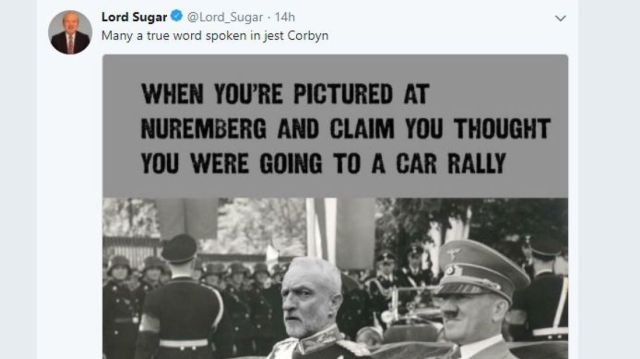
Lord Sugar and Hitler

This – from Lord Sugar – is simply deplorable.

skynews-hitler-jeremy-corbyn_4269370.jpg

Why is it that the Right concentrates so much of its venom on good and honest people – Obama, Corbyn…? It must be that they’re scared of them. As well, of course, as being bad and dishonest people themselves; and needing to display every public figure in a cynical light, in order to excuse their own duplicity and undermine confidence in democracy.

You really don’t need to be a ‘conspiracy theorist’ to see a hidden agenda behind the current campaign against Corbyn and his supporters on the grounds of their alleged ‘anti-semitism’.

Posted in Uncategorized | 2 Comments

Jews, Jezza, and Imperialism

Back to anti-semitism.

Just think. (1) How many specific examples of Labour anti-semitism have you seen quoted recently, to justify the charge that Labour has a ‘real problem’ here? All the accusations I’ve read, of ‘deep pockets’ of anti-semitism and the like, are vague and insubstantial. Others – Ken Livingstone daring to mention Hitler’s support for a Jewish National Home where he could send all Germany’s Jews (true), and Corbyn’s initial support for an anti-capitalist mural in London, with just two Jews portrayed among the six bankers supposedly ruling the world – cannot possibly be read as unequivocally and essentially anti-semitic. Here’s the artist’s own comment on the latter:

DZDU5DxXUAAjx9M.jpg-large

So Corbyn is probably wrong to renege on his support for it. But you can see why he did. He’s under seige.

I’m sure, as I’ve said before, that there are some anti-semites among Labour’s very large membership. But there are probably some paedophiles there too. That’s not to say that Labour has a particular or serious problem with either. I can understand why – in the light of their history – Jews and Jewish organisations feel sensitive over these issues; but that’s not to say that their suspicions are justified.

Second point (2). – I’m not a ‘conspiracy theorist’ – or don’t think so – but it was put to me by a friend recently that if Jeremy Corbyn became Prime Minister, he would be much less pro-Israel (pro-the present State of Israel, that is) and more pro-Palestinian than any of our recent PMs. That might be a reason for the so-called ‘Israel Lobby’ in Britain to smear him with one of the most shameful charges in post-Holocaust history, in order to prevent his coming to power.

And that’s easy enough to do, by lazily conflating criticism of the present right-wing Israeli government with racism. In fact a very large number of Jews, including many Israelis, are also hostile to Netanyahu’s regime, to Israel’s ‘occupied territories’, and the rest. (One of them is an acquaintance of mine who is working hard – and generously – for Israeli-Palestinian reconciliation.) Israeli right-wingers sometimes dub these critics ‘self-hating Jews’. Am I a ‘self-hating Brit’ because I’ve always opposed imperialism?

And what is Israel if it isn’t itself a consequence of imperialism? Remember that modern Israel was originally created as a Western colony in a land occupied for centuries by others. The same could be said of England, since the Anglo-Saxon invasions; and of course the United States. One difference with Israel, however, is that it happened much more recently, which means that the Arabs have closer memories of their dispossession than the Celts or the Native Americans. Which is emphatically not a reason to destroy Israel – we’re stuck with it now, and it has many admirable national qualities, especially when compared with some of the states surrounding it – but that the Israelis should be aware of their problematic origins, sensitive to the Arabs’ feelings as well as super-sensitive to their own, and more generous and accommodating towards their neighbours than they presently appear to be. That, after all, was the liberal and socialist dream that fired the original Zionists, with the considerable support of the British Labour Party in days gone by.

Posted in Uncategorized | 3 Comments