Koran-burning in Stockholm

No-one comes out of this incident well. The Iraqi immigrant who burned the book outside a Stockholm mosque most obviously – the burning of books has a poor historical reputation in Europe. But also the crowds of Muslims who demonstrated violently against the event in other countries, and have given the Turkish president another excuse to block Sweden’s joining of NATO; what on earth has a perceived insult to a religion to do with national defence? And of course it’s ridiculous that destroying a single copy of a ‘sacred’ text should give such offence to anyone, let alone a whole religion; which must itself damage the reputation of that religion – or of any organised religion – among rational people.

Thirdly, however: the Swedish authorities should have realised the harm the burning might cause, which would have been a practical if not a very principled excuse for disallowing it; which the police did initially, until overruled by the courts. Sweden is strong on ‘free speech’; but it also has laws against ‘incitement’, which I imagine were behind the police’s initial ban. We live in irrational times, which require us to appease even religious bigotry occasionally. If Sweden is to be condemned, it’s for its innocence; which is at least to be preferred to the bigotry of Salwan Momika (the arsonist) and the Moslem fanatics who are demonstrating against him.

Posted in Uncategorized | 1 Comment

Personifications

Whatever you may think of Donald Trump, Boris Johnson and Vladimir Putin – and if you’re reading this blog I guess it isn’t very much – you must be struck by the way the personalities of all three of them seem to reflect the present-day characteristics, or widely perceived characteristics, of their respective countries. Trump is a crooked capitalist who headed a crooked capitalist USA; Johnson a representative of the faux-aristocratic public school-educated class that the Brits (or at least the English) are supposed to have subjected themselves to for decades; and Putin, with his KGB background, could be said to personify the cruel autocracy that has been a feature of Russian life from Tsarist right through to Soviet times. Who could be more quintessentially American, or British, or Russian than these three?

Of course two of them are gone now, for the time being at least; and the third is possibly on his way out, thanks to Ukraine and Wagner – although I wouldn’t bet on it. Whether their successors will be quite so starkly representative of their nations remains to be seen. Rishi Sunak – public school, ex-empire, and a wealthy financier – reflects a slightly different, but still characteristic, side of modern Britain. In all these cases, our leaders mirror our dominant (but not necessarily typical) national characteristics in a quite remarkable way; far more than Wilson, say, or Thatcher, or Major ever did; or Khrushchev and the Bushes, for that matter.

*

Grateful thanks to those who sent me good wishes during my spell in hospital. I’m out now, and back in Sweden; to whose health service I’m about to entrust my elderly body tomorrow. (I’m afraid – and I’m reluctant to write this, in view of my principled and I think patriotic support for our NHS – that my English hospital made a bit of a mess of me.)

Posted in Uncategorized | 2 Comments

Intermission

Sorry for the long silence. I was unexpectedly whisked into (UK) hospital a month ago. Nothing serious, as it turns out, but some pretty unpleasant procedures before that was established; and I came out feeling worse than when I went in. With loving help from Kajsa and my children I’ve just managed the hairy journey back to Sweden, where I’m currently resting up, with tubes coming out of me, and about 24 tablets to swallow a day. Of course I’ve been following the crazy news from Britain, and hope to be well enough to comment on it in a few days’ time.

Posted in Uncategorized | 9 Comments

Patriotism and History

If nations can be said to have ‘identities’, most of them have multiple ones. Usually these are based on ‘history’, or on what has been cherry-picked out of their histories by people wanting to make patriotic or counter-patriotic points. Often they change fundamentally over time. The dominant British image of the Germans in the mid-19th century, for example, was of a dreamy and impractical people; the contrast with today could hardly be greater. National self ‘identities’ – even at the same time – can vary according to a number of factors: race, class, gender, ideological preferences, and what you were taught at school. I’ll bet, for example, that the histories of Britain that Boris, Rees-Mogg and Sunak were taught at their Public schools differed from mine, a grammar school boy’s. (I once wrote to Eton College to enquire about its history syllabus, and received no reply, so I can’t be sure; but Rees Mogg’s dreadful The Victorians – ‘a clichéd, lazy history’ that ‘often reads like it was written by a baboon’: that’s the Daily Telegraph, no less – may give some idea. Or was Jacob not listening properly?) In their cases it seems to have given them a glorified view of Britain’s past, which they believe can be extended into the present now that she has broken free from the shackles of Brussels. It also, of course, lies behind their present ‘culture wars’ onslaught on the ‘woke’ history that they believe is designed to undermine Britons’ pride in their past, and hence their patriotism.

My recent Britain’s Contested History: Lessons for Patriots (Bloomsbury, 2022) is intended to put them right about all this; not by denigrating Britain’s past, in order to make it something to be ashamed of – slavery, imperialism, and all the rest – which tends to be the approach of the counter-patriots; but by showing how complex that past was – the causes, motives and situations behind events – and so how superficial and misleading judgements about it, either way, can be.

British imperialism – one of my historical specialities – is a key example; and my research into which was probably the main reason why my view of Britain’s entire history has been – as you might call it – ambivalent. But the ambivalence went back further than this. I don’t remember much of my school history, in the 1950s, except that it omitted wars, the Empire and ‘kings and queens’ entirely; as did the undergraduate courses I took at university. That’s not at all to say that all these courses were devoid of at least an implied ‘patriotism’; but it was a very different kind of patriotism from the one that our Old Etonian (and perhaps Wykhamist) rulers seem to have imbibed from their educations two or three decades later. In my school I remember learning about the growth of political freedom in Britain; of various forms of emancipation – Jews, nonconformists, Catholics, the working classes, women (finally), homosexuals, slaves, and then the colonies; of the extension of ‘liberalism’ (understood as it was then, not so much today); of heroic movements of protest; and of the gradual amelioration of life for everyone – called ‘social reform’ – culminating in the welfare state. Resistance to Fascism was another of the themes we were made aware of, and which provided the main context for our study of World War II.

These were the cherries we picked; movements and events that ran through the ‘narrative’ of Britain’s modern history as we were taught it, and hence our ‘national identity’ there and then. It was also the narrative I broadly kept to when I started teaching modern British history in my first university job; not without acknowledging the counter-narratives of wars, oppression, upper-class domination, racism, atrocity and all the other evils that today’s anti-patriots emphasize – indeed, I dwelled on them; but preferring to believe that the ‘progressive’ features of our history had as much claim to define our ‘national identity’ as any others. That obviously tied in with the climate of ‘hope’, which, as I suggested in my last post, was a characteristic of the 1950s; and is no longer.

Today it is presented as irretrievably ‘woke’ on the political Right, including by the new ‘National Conservatives’, who have suddenly intruded upon our national scene (inspired, as I understand it, by the American Right). The ‘NatCons’ clearly have a very different notion of British ‘national identity’ from the one I was taught – and then taught myself – all those years ago. My sort, according to one of them – the awful ‘30p Lee’ Anderson – should ‘emigrate’ if we don’t like their version of ‘patriotism’. – Is it too far-fetched to be a little worried by the prefixing of the term ‘Conservative’ by ‘National’, in this context? Much as was done with ‘Socialist’, in pre-war Germany?

Posted in Uncategorized | 12 Comments

Nostalgia and Hope

Who now remembers the 1950s? I do. I grew up then, from 9 to 19 years. To later generations the fifties have been presented as rather boring and repressive, especially when looked back on through the glass of the ‘swinging sixties’, when everything supposedly sprang into life again.

At the time, however, the era didn’t appear like that to me. This was partly because I didn’t yet have the advantage of that golden next decade to view it through; and partly because – as I wrote in a review article about the fifties I published a few years ago (https://www.the-tls.co.uk/articles/swinging-fifties/), unless you were a woman, a homosexual or a criminal awaiting execution, the 1950s weren’t all that bad. That’s why I still harbour a degree of nostalgia for them. (And it’s not just because it was then that the adolescent me discovered ‘girls’. I was hardly allowed near them in any case: single-sex school, strict ‘moral’ upbringing, ignorance, and the like.)

I can acknowledge, and indeed recognise, the downsides of that era, even for a middle-class, male, heterosexual and law-abiding boy like me. I was fortunate in all those regards. But even for us relatively privileged people the food was still atrocious; TV black-and-white and blurry; people’s dress similarly monochrome; our rulers and radio presenters toffee-nosed (and nearly all male); our Empire  collapsing; the popular music infantile (quite literally: https://www.youtube.com/watch?v=safoNysTrbE); you couldn’t shop on Sundays; women were excluded from the best jobs; unmarried mothers were shamed and persecuted; and we boys could get caned for minor breaches of school rules. In addition, we all lived under the shadow of nuclear annihilation. Soviet spies were everywhere – especially in my old university, and (allegedly) at No. 10. Materially and socially, there can be little doubt that most things were a whole lot worse in the fifties than they are now. And yet

The fifties did have some admirable aspects, even by today’s materialistic standards. We were still recovering from the economic effects of the recent war, which had explained most of our earlier privations; and pretty well in the main. We could all – we males – get jobs, and one man’s salary could support a whole family. We had thriving industries again, especially making cars, ships and world-beating aircraft – i.e. big stuff; but now supplemented by a welfare state that protected what could be seen as the era’s victims, including a well-functioning National Health Service – our country’s pride and joy. Even the Conservatives accepted that. University education was free, with even our living subsidised. Foreign delights were beginning to assail us: cheap trips abroad, exotic dishes from the Empire, American music (jazz) and movies. All these were gradually adding lustre to our lives.

To compensate for the downsides of our national existence there were also burgeoning protest movements: against imperialism, South African apartheid, and – most prominently – ‘the Bomb’. On another level, we had Private Eye and the Goons to chip away at our betters’ toffee-nosed pretensions. Even imperial decline could be regarded positively, especially in the guise in which it was popularly presented: as less of a decline than a metamorphosis, from an ‘empire’ imposed from above to a free, equal, multiracial and self-governing ‘Commonwealth’. (What socialist could object to that term?) All these seemed – except to the most blimpish of Tories – to be signs of progress; and of an enduring progress: which is what gave the progressive people of that time – including me – a reason for hope. That was the conclusion of my TLS article, and is the main reason for my present 1950s nostalgia. Then was a time of hope. For most of us, today emphatically isn’t.

So, how did we get from there to here? The great turn took place, I think, in the later 1970s. It was then that we got Thatcher, Murdoch, foolish and short-sighted (or, if you like, over-powerful) trade unions, and – underlying everything – the inexorable progress and expansion into almost every corner of our lives of late-stage capitalism.

But that’s probably too simple. I may elaborate on it in a new edition of my old (and rather underrated, I think) Britannia’s Burden. The Political Evolution of Modern Britain, which stopped in 1990. That is, if I can sustain my enthusiasm and restore my fast-fading energy for the task; and then find a publisher to take it on. (No luck yet with that.)

Posted in Uncategorized | 3 Comments

Patriots and Republicans

You’ll have seen the news from Britain, that a number of ‘Republicans’ intending to peacefully demonstrate at King Charles’s coronation procession were arrested by the police before even getting their placards up, on the grounds that they ‘might’ cause trouble; and this after the leaders’ having squared their intended actions with the police weeks before the day. Rishi Sunak thinks this was OK. Coronations – and monarchy itself – are of course very British. (If you don’t like them, said the vice-chair of the Conservative Party a few days ago, then you should ‘emigrate’.) It follows that trying to protest or disrupt them in any way is ‘unpatriotic’.

Now: I don’t know what parts of Britain’s history our self-styled ‘patriots’ are particularly proud of; but if it doesn’t include popular protest then their list is seriously deficient. Of course our tradition of protesting is not nearly as impressive as France’s – a fact which was a cause of xenophobic pride in the 19th century (it showed how giddy the French were) – but there has certainly been a great deal of it over the years, on behalf of a number of causes, not all of them what we might regard as ‘progressive’, and most of them failing to achieve anything much; but many of them helping to speed things up in a way that leaving these issues to Parliament probably wouldn’t have done. Votes for men and for women are the obvious examples. Decolonisation may be another. Not that I want to claim that popular opposition to colonial misdeeds was the – or even ‘a’ – major factor behind the fall of the British Empire in the middle of the last century; but it was there, albeit unnoticed by many left-wingers today. As well as an ‘imperial’ Britain there was always an anti-imperial – or at least a deeply critical – one, which certainly contributed to her retreat from her colonies from the 1940s – or even earlier – on.

Anti-imperialism was of course the subject of my first book, Critics of Empire, published in 1968; and in subsequent books I’ve argued that indeed anti-imperialism, as a general philosophy, was invented in Britain, in a way that imperialism itself certainly wasn’t. (See British Imperial. What the Empire Wasn’t, 2016; and Britain’s Contested History. Lessons for Patriots, 2022). If we’re into ‘national pride’, and all the other ‘patriotic’ stuff, isn’t that something we Brits could be ‘proud’ of’? Even Charlie boy, in his purple robes and golden carriage; if he thought about it a bit. (He seems a thoughtful fellow.) In this sense, arresting republicans in the Mall for just being republicans, is almost the most unpatriotic thing one could imagine. We Brits are surely better than that; at least in patches.

Posted in Uncategorized | 4 Comments

Notre Dame

Warning: subjective artistic judgments ahead!

Why were the medievals such supreme architects, and yet so shitty at all the other arts? The great Gothic cathedrals of France, especially, have never been surpassed, while the literature, music, sculpture, drama and painting of the age pretty well languished until the Renaissance came along to buck them up. Rheims, Chartres, Salisbury and Durham are not only supreme aesthetically, but also in terms of their science. No-one after around 1450 was able to build structures as high and delicate as these merely by putting stones one on top of the other, and then to arrange and ornament them so beautifully. I once wrote a book about those who tried to revive the style in the nineteenth century, but who never succeeded in emulating their models. Those skills were lost to us when the early moderns came in.

The middle ages, in other words, marked the high point in all European history for one particular branch of culture, amidst a sea of pretty mediocre art otherwise. Talk up Dante, Chaucer, Giotto, and Guillaume de Machaut as much as you like; but none can hold a candle to these glorious achievements of an otherwise – by modern standards – primitive and oppressive time. To my mind the great cathedrals justify the European Middle Ages, in the same way that Mozart justifies the eighteenth century, in spite of all those centuries’ horrors otherwise. Let everything else on earth plunge into the sun, as apparently is our destiny ultimately; so long as the Sainte Chapelle and the Gran Partita – or at least memories of them – remain.

I’ve not yet pondered much on the reasons for this. Obviously Catholic Christianity was a factor – its ambition, lucre, and I guess its spirituality; together with developments in the science of construction; and the best of humanity’s instinctive desire to express the ineffable. Stone, of course, also lasts. I’ve read Panofsky on the relationship between mediaeval scholastic philosophy and the cathedral architecture of the time. But the answer to the question of ‘why architecture?’ still eludes me. I must look more into other cultures’ devotional architectures: Islamic and Buddhist, for a start. Were they as much ahead of the other arts of their times, as French Gothic was?

Posted in Uncategorized | 1 Comment

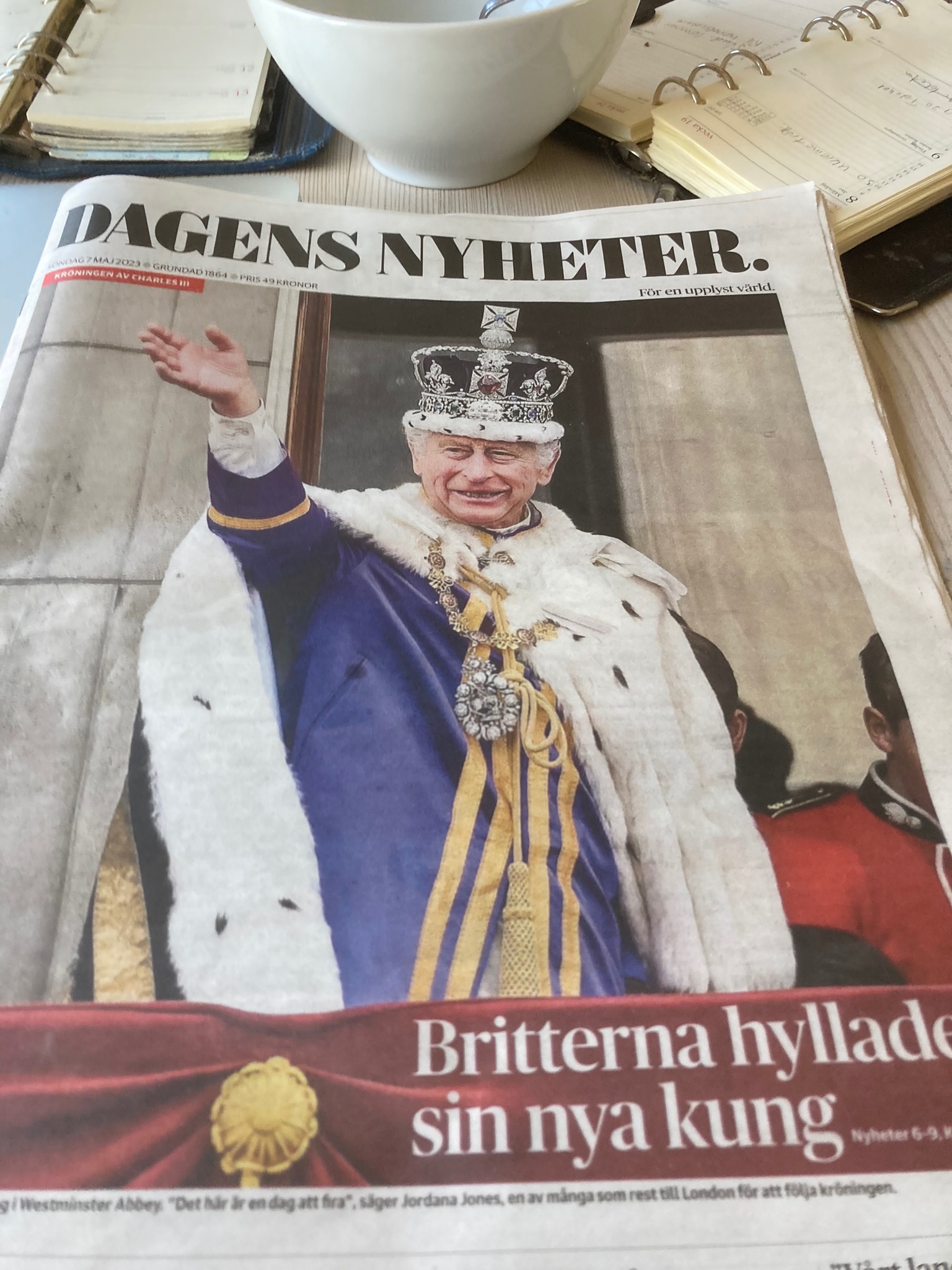
Den Kröningen

Yes, I watched it. I was surprised to find SVT1 covering the whole thing, here in Sweden. And Dagens Nyheter devoting its front page to it this morning.

Apparently foreigners admire us for this sort of thing – ‘no-one else does it so well.’ And yes, it was pretty amazing, in a theatrical kind of way. I particularly liked the performance of Penny Mordaunt, Leader of the House of Commons and Lord President of the Privy Council: the first woman to carry the Sword of State – a symbol of the king’s authority – during the procession. She did it well. Statuesquely, I thought. (And with even a glimpse of cleaveage.) Could she be the next Leader of the Conservative Party? She looks the part better than any of the last four. – Thank goodness it wasn’t the previous Leader of the House performing the role. Imagine Jacob Rees Mogg carrying the Sword of State – accompanied no doubt by Nursie. He would have loved it. But he would hardly have conveyed the dignity that our buxom Penny did.

But really: how pathetic! Having lost an empire, our industry, our welfare state and many of our proudest liberties, this – our flummery – is all we as a nation are left with. I felt embarrassed, as well as impressed; and not at all ‘proud’.

Not that I’m quite a republican. My ideal would be a much scaled-down hereditary monarchy: a bit like the Swedes’. I wouldn’t trust British electors not to choose someone far more embarrassing even than Charles III: a footballer, a popular singer, or a clown like Boris. Look what happened to America in 2016.

Posted in Uncategorized | 4 Comments

Führer Boris

I am the Führer.’ No doubt this was just a bit of badinage on Boris Johnson’s part (retailed by Michael Gove to the authors of a forthcoming book about his ill-fated premiership: https://www.theguardian.com/politics/2023/apr/22/i-am-the-fuhrer-im-the-king-new-book-lifts-lid-on-life-inside-boris-johnsons-chaotic-no-10); but it does seem to fit – uncomfortably – with much that is going on in the Tory party these days. It was apparently said by Johnson to one of his advisers, the notorious Dominic Cummings, who had dared to take issue with him.

People like Boris don’t like to be ‘advised’. Advisers are there to accept ministers’ orders unquestionably, and then to implement them. One gathers from the intemperate letter that another Dominic (Raab) wrote to the prime minister after his forced resignation from government a few days ago (https://news.sky.com/story/dominic-raabs-resignation-letter-in-full-12862454), that his attitude towards ‘advisers’ – in this case the regular Civil Service – is much the same. He accuses them – ‘the Blob’, as he calls them – of being an ‘activist’ cadre, anti-Brexiters all of them, plotting to derail his and his government’s policies come what may; and therefore deserving to be ‘bullied’ – the offence that caused Raab’s downfall – in the pursuit of administrative efficiency, and also – Raab contends – of ‘democracy’. It was the ‘people’, after all, who elected him. So who elected the Blob?

Well, no-one. But that could be one of the great virtues of Britain’s (otherwise very imperfect) democracy. Together with the similarly unelected House of Lords and our independent judiciary, it’s one of our main lines of defence against a constituency that occasionally oversteps the bounds of considered thought and action, and proposes or does things which without a bit more thought might turn out to be dangerous, or unwise, or impossible, or simply wrong. In other words, it acts as a corrective against the worst effects of what used to be called ‘mob rule, and now goes under the name of ‘populism’; that is, direct and immediate responses to popular votes without proper consideration of their likely repercussions, and possible need for amendment in the light of these.

Governments and ministers of all colours have for years bridled at the obstacles that the Civil Service – and the Lords, and the judges – have put in the way of their legislating as boldly and effectively as they would like. (Look at the memoirs of almost any post-war politician. Or the old TV comedy series, Yes Minister, so beloved by Margaret Thatcher.) Before today, however, none has sought so avidly and consistently to radically curb these ‘checks and balances’ as the present and recent Conservative governments: what with Priti Patel’s and Suella Braverman’s wars against both British and European justices (‘lefty lawyers’); Boris Johnson’s efforts to twist constitutional proprieties to get Brexit through; multiple sackings or enforced retirements of higher civil servants; the climate of fear that Raab has been shown to have created among his advisors if they dared to cross him; and the general and vicious hostility shown towards all these agencies in the right-wing press. – All this, in order to enable what the Right would consider to be ‘efficient’ government, in accordance with the supposed will of ‘the people’, unmediated by ‘Blobs’ and ‘traitors’; and led by the sort of ‘Führer’ that Johnson would apparently have liked to be.

Posted in Uncategorized | 3 Comments

Public Schools Through the Ages

Public schools (so-called) are getting a pretty poor press today, at least on the political Left, because of their privilege, their socially divisive influence, and products like Boris Johnson and Jacob Rees Mogg. But it wasn’t always so – or didn’t need to be.

Originally of course the most venerable schools were founded to provide education for poor boys (never girls) – hence the ‘Public’. Later they were taken over by the rich, usually as boarding schools, partly – one suspects – in order to keep their children out of their hair. For a long time this did little for their reputation, with their becoming notorious for bullying and cruelty, usually older boys against younger ones – see Tom Brown’s Schooldays – and occasionally for fighting with militia in the streets. These gave rise to a series of reforms in the early and middle 19th century, which effectively created the Public schools as we would recognise them today: finishing schools for upper-middle class boys with wealthy parents, or – more often – for middle-middle class parents who aspired to entry into the upper-middle class by this means.

That was because of the ‘aristocratic’ patina which attached to these schools, often emphasised by their ancient origins, either genuine or invented, by their antiquated ‘classical’ syllabuses, and by their styles of architecture, modelled on mediaeval or classical castles, mansions or palaces. In an increasingly ‘modern’ and ‘capitalist’ age these might seem to have been curious models to draw on; but there was a reason for it. For Victorian Britain was not uniformly capitalist, even economically, and certainly not in her culture and spirit; and indeed could still be considered ‘feudal’ in many respects. I’ve described her before as a ‘hybrid’ country: part modern, part ancient. The ancients tended to look down on grasping money-makers, with their lowly class origins and their materialism, philistinism and crude regional accents; and to dominate ‘high’ culture especially. Many of the ‘moderns’ shared these prejudices against their own kind, and consequently sought to escape from the stigmas associated with them. With their ill-gotten riches they too built Gothic or Palladian revival mansions for themselves, took up upper-middle class pursuits (like fox-hunting), struggled for ennoblements, and – more to the point here – sent their sons to the prestigious ‘public’ schools. This gave those schools a new lease of life in the second half of the nineteenth century; when they became – together with Oxford and Cambridge Universities – the main seminaries for Britain’s governing elites.

(Incidentally: something very similar can be seen in the private schools and ‘Ivy League’ universities of the USA – I’ve taught at Yale – although without the same degree of influence on the ruling classes there. And in Britain the prestige that the Public schools gained in this way trickled down to the free ‘Grammar’ day-schools, which began aping many of their ways: smart school uniforms, classical studies, ‘houses’, prefects, corporal punishment, rugger, begowned teachers (or ‘masters’), army cadet forces, childish nicknames, and all the rest. I went to one of these. Oh how we envied the echt Public schools! And incidentally: the PS model has even spread to Sweden. I taught a class recently at one of the new independent Internationella Engelska Skolan there. It reminded me of Hogwarts.)

The Public schools should have seemed old-fashioned even in the capitalist nineteenth century; and indeed, not altogether useful to the nation, if all they taught boys was how to memorise a couple of long-dead languages – easy enough if you have a good memory, otherwise the Classics don’t require much intelligence – and to speechify like Cicero. This was in addition to separating them from their families from an early age, and subjecting them to bullies and to various sexual temptations in their ‘dorms’. We know that this experience seared many of them personally. But from the country’s point of view, it worked.

The reason for this was that Victorian Britain didn’t want or need capitalists to govern them; and indeed the money-minded capitalists were not all that keen on governing themselves. Where was the profit in it? Unless, of course, you exploited your governing roles corruptly; which is where another aspect of the ‘Public school ethos’ came in. As well as despising merely mercenary occupations, it set against them another set of values, emphasising the duties which the well-off owed to those ‘beneath’ them, de haut en bas, derived from their feudal class origins, real or invented, and perfectly expressed in the phrase noblesse oblige; which could serve as the whole class’s motto. It was this, and the sense of ‘honour’ (trustworthiness, loyalty, truth, honesty) that came with it, which made Public school boys ideal leader, ruler and governor material; both in Britain – in the Civil Service, for example – but even more in her burgeoning Empire, which required ‘public spirited’ young men to rule it selflessly: more selflessly than the capitalists and settlers who were the only alternative ‘rulers’ on the ground could ever be. For most colonial servants, profiting commercially from their positions was expressly forbidden. They also – and this should be remembered when we want to make generalisations about both this class of men and the empire they ruled over – very often sought to protect their subjects, or wards, from the ‘capitalist imperialists’ who were exploiting them; occasionally successfully. (The capitalists were always complaining about them.) That was the role that the Public schools were supposed to perform in the 19th and for much of the 20th centuries; ideally, that is, for there were always of course a few exceptions. It wasn’t an ignoble role, and could be said to have justified – in part – the existence of the Public schools at that time.

However, when the Empire declined and fell, this particular job opportunity came to an end; with the result that the noblesse oblige and anti-capitalist ethoses (ethoi?) of the Public schools were rendered obsolete. The schools still supplied a disproportionate number of the British ‘establishment’ in public life, and of students at the ancient universities; but no more prime ministers, for example, between Home and Cameron. Most people during those years assumed that their day was done, and that the country had finally passed into the hands of State school boys (and girls); reflecting the new and more modern social composition of the country generally. No-one paid much attention to the surviving Etons and Winchesters of the 20th and 21st centuries; until the early 2010s, when the corpse unexpectedly broke out of its tomb.

Except that it wasn’t any longer the same creature. By 2010 the Public schools had transformed themselves, in line with the evolution of the British upper class generally, into a gilded institution for people who could afford to go there (many of them equally privileged foreigners); which now generally meant the nouveau riche rather than the noblesse. Which might have been acceptable if the schools had preserved at least some of the ‘ethos’ that had distinguished them in former years: honesty, trustworthiness, sympathy,  ‘character’ and all the rest of what had been reckoned to make a ‘gentleman’ in earlier days; and, perhaps, had taught some Keynes (or even Marx) instead of – or at least in addition to – Cicero. By the 1900s, however, these admirable values appear to have been sucked out of the schools, leaving only the husk of ‘privilege’ to recommend them; together of course with the ‘connections’ they provided with ‘old boys’, who were established in high positions already.

Shorn of the old ethos, the Public schools had very little going for them that could be said to particularly fit them for the task of government in the 21st century. Their schooling stood their pupils apart from 99% of the people they were called upon to govern, in a way that previous Public schoolboys – those for example who had fought in wars: Churchill, Attlee, Macmillan – had managed to avoid. Judging by the current crop of them, especially the buffoons Johnson and Rees Mogg, their education did not compensate for this by teaching them to think seriously, or even at all. Simon Kuper’s new book Chums. How a Tiny Caste of Oxford Tories Took Over the UK (Profile, 2022) – an essential read for anyone wanting to understand the inanities of our recent and present political leaders – blames it on the culture they imbibed at the Oxford Union, especially its amoralism and superficiality; with (supposed) wit and ‘winging it’ always trumping wisdom and hard work. But it was at Eton that Boris and Jacob first forged their personae.

Personally, I recognise a great deal of this from when I was at Cambridge in the 1960s: enough to convince me of the biting accuracy of Kuper’s account. But then we ‘Grammar school oiks’ found it pretty easy to avoid them there. I only wish the country had also managed to.

Posted in Uncategorized | Leave a comment