Riots and History

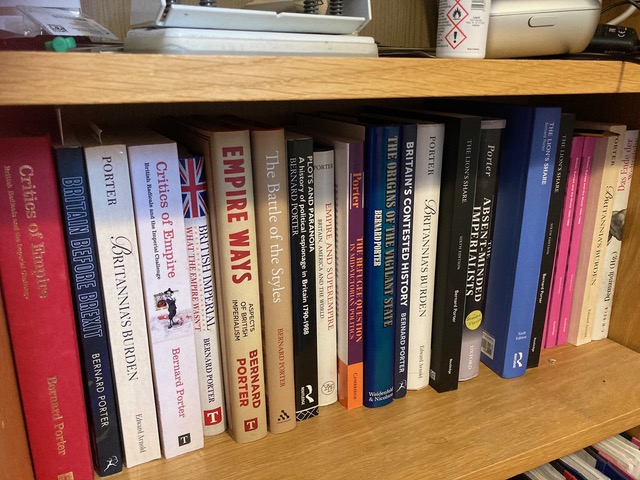
This is the first time I’ve seen all my books stacked together – with a couple of duplicates, but minus a few later editions. I brought them back with me to Stockholm last month.

It occurs to me that having written all these books (and a few articles) on refugees, colonialism, the police and British ‘national identity’, I wonder why I’ve not been approached by the media for my views on the present traumatic situation in British cities, when those views might surely be of interest and even relevance?

But then the fairly distant past – which is where I’ve lived all my professional life – is rarely of interest to politicians, journalists and rioters, except to be simplified, distorted and cherry-picked for propagandistic reasons; leaving us more discriminating ‘experts’, as Michael Gove once sneeringly dismissed us, sobbing impotently on the margins of public life.

I’m following the news coming from my English home town from afar, and with increasing sorrow and anger; but also encouraged by the fact, as reported, that the pro-refugee counter-demonstrations far outnumber the neo-Fascist ones. The Ukrainians I’m sheltering in my Hull house tell me they are safe, but not daring to venture into the city centre.

More on this (I hope) later.

Posted in Uncategorized | 1 Comment

Anonymity

The horrible knife-murders of those very young children at a dance class in Stockport the other day, and the violent riots that followed them there and elsewhere, the latter exploited if not directly incited by the far Right, are deeply depressing. I’d hoped that with the election in Britain of a superficially less ‘nasty’ new government a month ago this sort of thing would have begun to die down. Not a bit of it – yet. But then the grievances behind the rioting, real and imagined, and the hatreds that have been stoked by people like Farage over the last fourteen years of Conservative rule, are too ingrained to be eliminated by a few million crosses on ballot papers. They run too deep and wide. Labour needs time.

One of the (many) villains of this piece identified currently is (or are) the ‘social media’: internet-enabled discussion and propaganda platforms owned by rich millionaires but open to everyone, and hardly policed at all, it seems, by any kind of moderating authority. It’s the social media which has been disseminating most of the lies that are used to justify the attacks that have been launched against mosques, the police, and more indiscriminately; on the grounds that the knife-murderer is a refugee, even one of the small-boat Channel-crossing asylum seekers that Farage has particularly in his sights, and a Moslem: none of which appears to be true. Millions of people soak up these lies; with the results we’ve just seen, and may be repeated later. Many young men apparently just love having an excuse to smash things up. (That – toxic masculinity – is another area that needs to be explored if we are to get to the bottom of the Southport shenanigans.)

I’ve nothing useful to contribute to the discussion on this, apart from one idea – and that not a terribly original one. A key feature of the social media is that people’s contributions to it are allowed to be either anonymous, or pseudonymous (written over pen names). The arguments from principle for this are that it encourages ‘free speech’, which might be cramped if you have to attach your name to everything you write; and so attracts more people to offer their opinions, which makes it more ‘democratic’. These were the points that were put to me when, ten or a dozen years ago, I first objected to this practice either on the LRB blog, or on my own blogsite in its early days. (I’ve searched back for this particular post, but can’t find it now.) I remember that I made a good case there for outlawing ‘anonymous’ posts altogether, except in certain specific and narrow circumstances, like ‘whistle-blowing’, or where it might lose one one’s job. Otherwise anonymous blogs, tweets and the like should be regarded like anonymous letters usually are; in other words, as a mark of sheer cowardice, absolving the perpetrators from all accountability for their actions and views.

Posted in Uncategorized | Leave a comment

Israeli Fascism

One of the profoundest sorrows of my life as an observer of politics is the way Jews, once the most visible and extreme victims of Fascism, have now taken on many of the attributes and actions of Fascism themselves. I say ‘Jews’, and emphatically not ‘the Jews’, because Netanyahu and his clique are clearly not representative of Jewry generally; with most Jews being – I like to think – as unsupportive of Israel’s hideous crimes in Gaza, and of the religio-racist ideology that appears to be one of the factors lying behind them, as are most of the goyim. You’ll find opposition to Israel’s present policies in Gaza, and even to the idea of a single-religion-dominated State of Israel itself, widespread in the Jewish diaspora, even among the Rabbinate; scotching the accusation that it must be an ‘anti-Semitic’ trope.

That of course is the charge, together with the terrible memory of the Nazi holocaust, which has protected Israel from some of the criticism that it might otherwise justly have attracted to itself, and is normal when deployed against other similarly aggressive and colonialist powers. The charge of anti-Semitism, ‘weaponised’ in this way, has a lot to answer for; quite apart from crippling the British Labour Party under Jeremy Corbyn in the late 2010s, and so prolonging the political mayhem that the Conservatives inflicted on us afterwards – until Labour found a new more Israel-friendly leader for itself. I personally shall never forgive the ‘Israel lobby’, as it’s called, for this. It has done much to erode much of the pro-Jewish feeling I instinctively used to share with most other progressive Britons, before then.

What I fervently wish is that Judaism could revert back to the purely personal belief-system that most religions are, enriching the cultures of all the societies that harbour it: this of course depends on those societies tolerating it; or, if it still feels it requires a state apparatus to protect it from future holocausts, to have its Israel, but more liberally conceived, side-by-side with a viable and hopefully friendly Palestinian state, and – crucially – based on the frank admission that the acquisition of land from the their previous Arab occupiers in the 1940s and ’60s, was a crime. And, of course, there must be none of this nonsense about God ‘promising’ it to them. That only fools Jewish Zionists and American Evangelicals. Why should the Godless amongst us have any truck with it?

Many other nations are established on ‘stolen’ lands: the USA among them. Israel is not alone in this regard. What might make a difference is to acknowledge it, apologetically, as I think Americans do; and to proceed on from there. – But in the present situation this does, I admit, seem naïve.

Posted in Uncategorized | 1 Comment

Poor Harold

I regard Harold Wilson as one of the greatest of our peace-time prime ministers: monstrously vilified at the time from the political Right – paranoiacs in MI5 even had him marked as a Soviet spy – but a good and highly intelligent man, an effective unifier of his fissiparous party, a great enabler of social and educational reform, the man who kept us out of the Vietnam war, and a great Yorkshire ‘character’, if you weren’t an upper-class snob. He retired as PM unexpectedly, and relatively young: some said as a result of the constant right-wing plotting against him, but more likely because of the incipient Alzheimers that first surfaced when he once lost his way in a Labour conference speech. It was very sad: for him personally of course, but also for the country; and the personal tragedy is underlined by this report in today’s Guardianhttps://www.theguardian.com/politics/article/2024/jul/23/former-pm-harold-wilson-sold-private-papers-fund-care-alzheimers – where it is revealed that he fell into such bad times in retirement that he contemplated selling his private and governmental papers to cover the cost of his social and medical care.

Of course today no retiring PM would be – or has been – left in such a predicament. The Tory ones of course have usually had considerable private funds in any case, which they could supplement with generous gifts from those they had ‘helped’ as prime minister. Then there are memoirs to be written (or ghost-written); well-paid journalism in right-wing newspapers; lectures to wealthy ‘think-tanks’, especially in America; and highly-paid directorships or consultancies for friendly companies and agencies. On the (relative) Left, Tony Blair seems presently to be making a mint in most of these ways, as an enterprising and bankable ‘Ex’. And Gordon Brown is doing OK.

But these options appear not to have been open to Wilson. I don’t suppose either of his autobiographies made him rich. He had few wealthy patrons (Lord Kagan, the raincoat man?). And the celebrity lecture tour was less of a feature then, even if he could have been trusted to overcome his dementia to speak intelligently.

But then ‘high’ politics then was less seen as a road to riches than it seems to be today. Most of our MPs and Ministers give the impression of being in it for themselves, financially and reputation-wise: ‘career choices’; as you would expect in a capitalist society, where individual ‘betterment’ is a bigger desideratum than any idea of ‘service’. Look at Boris. This may be an essential difference between Wilson’s time and ours. I’m hoping – rather optimistically – that Starmer and his team might turn the clock back in this regard.

Posted in Uncategorized | 2 Comments

Brick Gothic

An unexpected pleasure of our long drive up from Rotterdam to Stockholm was to visit the north German/Hanseatic churches along the way; all built in brick, usually regarded as an inferior building material to stone – more domestic than monumental – but often disguised as stone in their soaring interiors, which may attest to this. I’ve never before seen such tall, narrow late Gothic windows.

Or so many wind turbines – graceful, natural, and greatly beautifying the countryside, in my view. Are there no Nimbys in northern Germany?

PS. I know there are other examples of brick Gothic, including in my own stone-poor county of Essex. But none so impressive as these.

Posted in Uncategorized | Leave a comment

JD Vance

For those of you who haven’t come across these already, here are Trump’s running-mate’s takes on (a) Donald Trump himself in 2016; and (b) the corrosive effect of his own alma mater (Yale), and of universities generally, today. The first is remarkable not only for the volte-face it illustrates in order for Vance to be able to come to the support of Trump in 2024, but also, I believe, for its generally intelligent reading of the situation in ‘rust-belt’ America eight years before. The second is a vivid example of what I would regard as the ‘anti-intellectualism’ which powers many ‘populist’ movements on both sides of the Atlantic presently. Academics (and ex-Academics), beware!

(a) Opioid of the Masses 

To many, Donald Trump feels good, but he can’t fix America’s growing social and cultural crisis, and the eventual comedown will be harsh. 

By J. D. Vance JULY 4, 2016 

 A few Saturdays ago, my wife and I spent the morning volunteering at a community garden in our San Francisco neighborhood. After a few hours of casual labor, we and the other volunteers dispersed to our respective destinations: tasty brunches, day trips to wine country, art-gallery tours. It was a perfectly normal day, by San Francisco standards. That very same Saturday, in the small Ohio town where I grew up, four people overdosed on heroin. A local police lieutenant coolly summarized the banality of it all: “It’s not all that unusual for a 24-hour period here.”

He was right: in Middletown, Ohio, that too is a perfectly normal day. Folks back home speak of heroin like an apocalyptic invader, something that assailed the town mysteriously and without warning. Yet the truth is that heroin crept slowly into Middletown’s families and communities—not by invasion but by invitation. Very few Americans are strangers to addiction. Shortly before I graduated from law school, I learned that my own mother lay comatose in a hospital, the consequence of an apparent heroin overdose. Yet heroin was only her latest drug of choice. Prescription opioids—”hillbilly heroin” some call it, to highlight its special appeal among white working-class folks like us—had already landed Mom in the hospital and cost our family dearly in the decade before her first taste of actual heroin. And before her own father gave up the bottle in middle age, he was a notoriously violent drunk.

In our community, there has long been a large appetite to dull the pain; heroin is just the newest vehicle. Of course, the pain itself has increased in recent years, and it comes from many places. Some of it is economic, as the factories that provided many U.S. towns and cities material security have downsized or altogether ceased to exist. Some of it is aesthetic, as the storefronts that once made American towns beautiful and vibrant gave way to cash-for-gold stores and payday lenders. Some of it is domestic, as rising divorce rates reveal home lives as dependable as steel-mill jobs. Some of it is political, as Americans watch from afar while a government machine that rarely tries to speak to them, and acts in their interests even less, sputters along. And some of it is cultural, from the legitimate humiliation of losing wars fought by the nation’s children to the illegitimate sense that some fall behind only because others jump ahead. It enters minds, not through lungs or veins, but through eyes and ears, and its name is Donald Trump.

During this election season, it appears that many Americans have reached for a new pain reliever. It too, promises a quick escape from life’s cares, an easy solution to the mounting social problems of U.S. communities and culture. It demands nothing and requires little more than a modest presence and maybe a few enablers. It enters minds, not through lungs or veins, but through eyes and ears, and its name is Donald Trump. Last Sunday, the day before Memorial Day, I met a Marine veteran of the Vietnam War at a local coffee shop. “I was lucky,” he told me. “At least I came home. A lot of my buddies didn’t. The thing is, the media still talks about us like we lost that war! I like to think my dead friends accomplished something.” Imagine, for that man, the vengeful joy of a Trump rally. That brief feeling of power, of defiance, of sending a message to the very political and media establishment that, for 45 years, has refused to listen. Trump brings power to those who hate their lack of it, and his message is tonic to communities that have felt nothing but decline for decades.

In some ways, Trump’s large, national coalition defies easy characterization. He draws from a broad base of good people: kind folks who open their homes and hearts to people of all colors and creeds, married couples with happy homes and families who live nearby, public servants who put their lives on the line to fight fires in their communities. Not all Trump voters spend their days searching for an analgesic. Yet a common thread among Trump’s faithful, and even among those whose individual circumstances remain unspoiled, is that they hail from broken communities. These are places where good jobs are impossible to come by. Where people have lost their faith and abandoned the churches of their parents and grandparents. Where the death rates of poor white people go up even as the death rates of all other groups go down. Where too many young people spend their days stoned instead of working and learning. Many years ago, our neighbor (and my grandma’s old friend) in Middletown moved out and rented his house on a Section 8 voucher—a federal program that offers housing subsidies to low-income people. One of the first folks to move in called her landlord to report a leaky roof. By the time the landlord arrived, he discovered the woman naked on her couch. After calling him, she had started the water for a bath, gotten high, and passed out. Forget about the original leak, now much of the upstairs—including her and her children’s possessions—was completely destroyed.

Not every Trump voter lives like this woman, but nearly every Trump voter knows someone who does. Though the details differ, men and women like my neighbor represent, in the aggregate, a social crisis of historic proportions. There is no group of people hurtling more quickly to social decay. No group of people fears the future more, dies with such frequency from heroin, and exposes its children to such significant domestic chaos. Not long ago, a teacher who works with at-risk youth in my hometown told me, “We’re expected to be shepherds to these children, but they’re all raised by wolves.” And those wolves are here—not coming in from Mexico, not prowling the halls of power in Washington or Wall Street—but here in ordinary American communities and families and homes.

What Trump offers is an easy escape from the pain. To every complex problem, he promises a simple solution. He can bring jobs back simply by punishing offshoring companies into submission. As he told a New Hampshire crowd—folks all too familiar with the opioid scourge—he can cure the addiction epidemic by building a Mexican wall and keeping the cartels out. He will spare the United States from humiliation and military defeat with indiscriminate bombing. It doesn’t matter that no credible military leader has endorsed his plan. He never offers details for how these plans will work, because he can’t. Trump’s promises are the needle in America’s collective vein.

The great tragedy is that many of the problems Trump identifies are real, and so many of the hurts he exploits demand serious thought and measured action—from governments, yes, but also from community leaders and individuals. Yet so long as people rely on that quick high, so long as wolves point their fingers at everyone but themselves, the nation delays a necessary reckoning. There is no self-reflection in the midst of a false euphoria. Trump is cultural heroin. He makes some feel better for a bit. But he cannot fix what ails them, and one day they’ll realize it. I’m not sure when or how that realization arrives: maybe in a few months, when Trump loses the election; maybe in a few years, when his supporters realize that even with a President Trump, their homes and families are still domestic war zones, their newspapers’ obituaries continue to fill with the names of people who died too soon, and their faith in the American Dream continues to falter. But it will come, and when it does, I hope Americans cast their gaze to those with the most power to address so many of these problems: each other. And then, perhaps the nation will trade the quick high of “Make America Great Again” for real medicine.

(b) The Universities are the Enemy

https://bryanalexander.org/politics/the-professors-are-the-enemy-j-d-vance-on-higher-education/.

Looking back to the 1930s, doesn’t this sound just a little Fascistic to you?

Posted in Uncategorized | 4 Comments

Interval

Even serious works – like this blog – need a scherzo. Here’s mine for now; some superficial holiday observations.

After a pleasant month in Less-than-Great Britain, Kajsa and I are now on our way back to Sweden: her lifelong home and my alternative one. She is privileged, I feel, to have experienced some interesting moments in British history, including a history-changing (we hope) national election, and a typically honourable defeat in the football. Our Swedish friends will be hanging on her every report.

For me the journey back has been equally enlightening, although in ways that have only confirmed most of my prejudices. We’re taking the long route back – we didn’t want to expose our beloved dog to a flight in a cage in the hold – by overnight ferry between Hull and Rotterdam; and then Kajsa driving all the way up to (and down from) Stockholm. (I’m no longer allowed to drive. Poor eyesight.) It took us four days each way, and four overnight stays (if you include the ferries), but took us to some marvellous places: Rotterdam, Utrecht, Bremen, Lübeck, Rostock, and a town in southern Sweden I’ve forgotten the name of. (It’s famous for its peppermint rock.) I know Germany pretty well – Köln was my first trip abroad, in a school party – but mostly the south. Northern Germany therefore, and the Netherlands, were new to me

What impressed me were the cleanliness and tidiness of all the places we passed through; the wonderful brick cathedrals with slender copper double spires; the way the motorways were sheltered from the communities behind them with beautiful tall fences covered with greenery; the multiplicity of ‘health and fitness’ shops in the towns; and – despite this – the number of ‘beer bellies’ walking about. On the boats I was also impressed by the efficiency and helpfulness of the Asian staff, even though they were all ‘blacklegs ’ taken on after P&O’s mass sacking of the British crews a year or two ago. Should I not have travelled with them?

It has been a welcome break from the intensity, excitement and depression of British, American and French politics over the last few years; and a sign – even the beer bellies – of what might have been, but for that disastrous referendum vote in 2016. But of course it’s not all – or even mainly – due to Brexit.

And of course I only experienced a beautifully manicured Germany. AfD reminds us that the old devils stalking her have not all been exorcised.


Posted in Uncategorized | 1 Comment

Where are the Conspiracy Theorists?

Apparently the suspect in the latest assassination attempt against Trump – young Thomas Crooks, killed on the spot, of course, as American suspects tend to be – was a registered Republican, and a poor shot. (That’s what we’re told so far.) So surely one of the tinfoil hat brigade will be coming along soon with a ‘grassy knoll’ theory to ‘prove’ that he was a ‘patsy’, and that the whole event was a put-up job by Trump supporters to engender enough sympathy for him to return him to the White House?

And if ‘images’ are important in American politics, this one, mirroring an iconic one from the Korean war, should be pretty effective:

https://www.telegraph.co.uk/us/politics/2024/07/14/bloodied-face-fist-raised-image-win-trump-presidency/

So: has Trump got it won already? And, to take a broader historical perspective: isn’t this, political violence, a more convincing political narrative, more dominant in US history, than the ‘democratic’ one that most Americans prefer?

Posted in Uncategorized | 2 Comments

C’mon England (But Nicely)

I watched the 1966 World Cup Final on TV yesterday afternoon – the first time I’d seen it in colour. (Colourised?) I was impressed by (a) the lack of play-acting after fouls – victims got up quickly and even shook hands with their assailants; (b) no black players; (c) the divine Bobby Moore, Mr West Ham; and (d) the Duke of Kent (I think it was) smoking a cigarette in the stands. The Sixties really were a better time. (Not of course if you were a woman. Or gay. Or black. Or allergic to cigarette smoke.) – But now I’m sounding like a boring old fart.

I actually went to one of the group matches then, courtesy of a Canadian friend who got tickets from his High Commission. I think it was the infamous Argentine game. That was a nastier affair.

I’ll be watching this evening, fuelled by an afternoon carvery dinner at my favourite Hull pub (named after Philip Larkin). It will be nice if the game is as gentlemanly as that Final in 1966. If it is, I won’t be too worried about the result. But then I’m a boring old moralist, too.

Posted in Uncategorized | 1 Comment

Hope At Last?

Sorry yet again for the long silence. A (minor) eye operation and various social commitments have intervened. Plus loss of energy. Isn’t old age a bugger? ‘Never get old’, as I tell my younger friends; until I realise what the alternative is.

Obviously lots has happened since I last posted, most of it good: the Labour electoral ‘landslide’ (eh? with 30-odd per cent of the vote?); England reaching the men’s Euro soccer final; and our boys trouncing the West Indies in cricket – albeit embarrassingly easily. I miss the days when the Windies were really a team to be reckoned with. And when the Tory party was a decent and honourable opposition.

This is clearly a transformative time in British history, equivalent to Thatcher’s win in 1979; and, more alarmingly, in the world’s, albeit in a different direction there, with something akin to neo-Fascism on the political rise all over. You can see why: economic uncertainty, charismatic populists, and – possibly – a basic and rather unpleasant instinct in most of us. Keir Starmer has a tough task ahead of him. First he has to renew people’s trust in politicians and politics, after the last fourteen years of  corruption and farce on the Tory side, and the ‘they’re all the same’ cynicism they seem to have engendered. He seems to be doing well on that – but it has only been a week. Then we’ll see where he goes on the other crucial issues: cost of living, the NHS, social care, inequality, our awful press, prisons, defence, Europe, Trump, immigration, Ukraine, Gaza, the climate…  None of this is likely to affect the current Rightward turn in global politics; but it may soften the latter’s blows for us unreconstructed social democrats, and act as a flickering beacon of hope for others.

In the meantime there’s Sunday’s European final for us to look forward to, albeit nervously. I see that the latest slogan on the yobbos’ t-shirts is ‘Two World Wars and one Referendum’. Basic instinct?

Posted in Uncategorized | 1 Comment