Ageing

We ought to be allowed to grow old without being made to feel guilty about it. I’m afflicted with several infirmities just now, in joints, eyes, ears, teeth, memory, and whatever is supposed to control my sleeping. My doctor tells me these are ‘just signs of old age’. ‘But my partner is about the same age’, I protest, ‘and has none of these afflictions’. ‘That’s because she’s a woman,’ he replies; ‘and women age more slowly than men. It also means you’ll die before her.’ I feel my doctor lacks something in the bedside manner department; but in fact I appreciate his directness and honesty. (He’s a great diagnostician.) And ‘just old age’ makes me feel better about my aches and pains. They’re not my responsibility. I can live (and die) with that.

For others who are closer to me, however, my minor infirmities are all my fault. They’re because I eat badly, am lazy, and take too little exercise. So I need to embark on a programme of eating nothing but greens and really hard jogging. I doubt it. (Jogging isn’t going to be very good for my arthritis.) But really, the ‘programme’ is a way of shifting the burden of suffering on to my own shoulders. I prefer my doctor’s diagnosis. Ageing is ‘natural’.

But then along comes the Government, blaming the current problems of the NHS on ‘people living longer’: in other words, on the likes of me. Because we’re older, we need more care. We’re blocking the hospitals, impoverishing them with our demand for new hips and incontinence pants, and – of course – not paying for it any more through our taxes. We’re just burdens. Conscious of this, I’m loathe to visit my doctor any more. I feel I’m taking up time and expertise that would far better be used on younger, still productive members of society.

I’m also afraid that my fears of an ache or a pain being symptomatic of something really bad – cancer, say, or heart problems – will be dismissed as ‘hypochondria’. In other words, I have an irrational fear that I’m hypochondriacal about being a hypochondriac. (Is there a special word for that?) So I just soldier on; suffering quite happily – I don’t complain, and it gets me out of doing certain things; and reconciling myself to my ultimate fate. Later this week I’m part of a test at the famed Karolinska Hospital covering all 75-76-year olds in the Stockholm region to discover early and hidden symptoms of incipient heart failure. I’m quite looking forward to that. It should reassure me, without my having to ask for the test, which might have made me appear hypochondriacal.

But my general point is this. What has the NHS come to, that it deters its most vulnerable patients from seeking the advice they are entitled to, in case they – and they in particular – are overloading it? As an oldie, I don’t feel safe in Britain any more.

Posted in Uncategorized | 1 Comment

Back to Sweden (and Sanity)

On my way back to sane, sensible, quasi-socialist and genuinely ‘strong and stable’ Sweden. It will be interesting to see how my Swedish friends are reacting to our current British nonsense, which I imagine will have had been fully covered in Dagens Nyheter, Svenska Dagbladet, and on SvT. (They all have excellent London correspondents.) I’ve given up trying to defend us. Perhaps if I pretend I’m Irish – I can do the dialect – just as US citizens pretend they’re Canadians nowadays, I may be able to avoid the inevitable derision, or – worse – the pity. Whatever else they may achieve in the time they have left to them, the Tories have already made us laughing stocks abroad.

Then down to Denmark briefly, for some hygge and racism.

Posted in Uncategorized | Leave a comment

Edward Heath

The 1960s, ’70s and ’80s may have been a particularly corrupt period in British politics and high society. There were Right-wing and secret service plots against the governments of Harold Wilson; shocking examples of subversion in Northern Ireland; the Hillsborough scandal; anti-union machinations; a number of sexual shenanigans (‘affairs’); much financial corruption (which in my view is more serious); regular police wrongdoing, ‘fitting’ suspects ‘up’, secretly infiltrating protest groups, and the like; a number of proven instances of paedophilia among establishment figures, one of which I was personally close to and have blogged about (https://bernardjporter.com/2016/03/17/cambridge-and-homosexual-harassment/); and much more – a significant amount of which the ‘Establishment’ of the time was able to cover up, because it had the power to. Much of it has only been unearthed recently.

At one time I thought of writing a ‘secret history’ of these years woven around this theme, but never got round to it. Someone ought to do it, in order to try to measure it: was it really unique to this period? probably not; and to tease out the reasons for it: right-wing fears of socialism, the Cold War, the decline of conventional morality, the public schools, the Empire, British traditions of secrecy (just suggestions), and so on. It would provide an interesting counterpoint and corrective to conventional histories of our ‘democracy’.

Even before that book has been written, however, these revelations have stained the reputation of the past. This explains why it is possible for us to credit the charges of paedophilia against Edward Heath that are the subject of today’s (inconclusive) report by the Wiltshire police. After all, if that fat Liberal MP from Lancashire was a child abuser, why not him? And that’s so whether the charges against Heath are true, or not. Which is unfortunate for his memory if he was innocent. And we know enough about false evidence from pretended victims to know that this could be so.

Even when he was alive Heath was always suspected of being a homosexual, in an age when a prominent male figure couldn’t ‘come out’ as gay without sacrificing his career and – early on – even his liberty. It was also an age when men and women were supposed to be married. If you weren’t, it automatically opened you up to doubt. Every bachelor was suspected of being ‘queer’, and if you were queer it followed that you were attracted to boys.

Of course it didn’t necessarily follow. Some men – and I always thought Heath might be one of these – are simply asexual. It’s odd how ‘asexuality’ isn’t generally included when we’re dividing people up into sexual categories, along with heteros, homos, trans, bi’s and all the rest. It must be quite a pleasant condition. Restful.

Posted in Uncategorized | 2 Comments

Progress

Being old-fashioned doesn’t necessarily mean you’re wrong. Of course it does with our Old Etonian fop Jacob Rees-Mogg, MP, the surprising new darling of the Conservative faithful; but then pushing ‘old-fashioned’ back 200 years is a bit of a stretch. Since then things have got better. For a start we (the British) now have democracy, of a sort; have stopped trying to rule the world; and have advanced tremendously in how we look after our people – a.k.a. ‘social reform’. That took a long, heroic struggle during those 200 years, mainly by ‘ordinary’ folk and their enlightened leaders, against the forces of ‘reaction’. It was called ‘progress’. We all agreed on this. While it was going on, the old ways were, quite reasonably, dismissed as ‘backward’.

But then a curious change took place. History – not only in Britain, but in America too – itself took a backward step. It was done quite deliberately, as witnessed by Margaret Thatcher’s explicit call for a return to what she called (misleadingly, I believe) ‘Victorian values’. But they were no longer called ‘backward’. Instead, free marketism was viewed as the new ‘progressive’ way, and yesterday’s ‘progressives’ cast as the villains who had turned our history ‘back’. Unrestricted capitalism was the new expression of ‘modernity’. (Marx, incidentally, would have agreed. Did Thatcher realise what a Marxist she essentially was?) It was the welfare state, the mixed economy and trade unions – those engines of progressiveness up until then – that were old-fashioned. Thatcher, Major, Blair and Cameron all danced to this tune, as they sought to free up and so ‘modernise’ the British economy. People came to accept this new definition of ‘progress’. All you had to do in order to dismiss anyone with vaguely ‘socialist’ ideas, for example, was to present them as a throwback to the 1970s. That was enough, supposedly, to make Jeremy Corbyn unelectable. Never mind the virtues of his policies, such as they may have been. There was no need to debate them on their merits. Their ‘backwardness’ was enough, on its own, to damn them. We’d been there before. (And what had it brought? Endless strikes, apparently; unburied corpses; and swivel-eyed Bennery.) We had to ‘move on’: for the sheer sake, it seemed, of moving on.

Thus does ‘progress’ become defined: relatively to the politics and mythology of the day. One period’s reaction becomes the next’s progress, and vice-versa. (I give another example of this in https://www.lrb.co.uk/blog/2015/08/07/bernard-porter/whos-a-dinosaur-now/.) But this can change too. Many on the Left today – though they don’t like to say so – are literal reactionaries, because they want to go back to (some aspects of) the 1970s too. They (we) see that decade as the one where their (our) sort of ‘progress’ faltered, to be replaced by one which seemed at the time to be more up-to date, but in fact was ideologically far more regressive. In any case, whichever it was, it shouldn’t have been distinguished by the name of ‘progress’, which simply deterred people from looking at its true merits and demerits. And as the demerits of Thatcherite capitalism become clearer and clearer today, there’s just the chance that socialism might take up the banner of ‘progress’ again. Which could give it a fillip among those who only follow ideas – like wearing clothes – that are fashionable. (I’ve always stuck to my 1970s gear, by the way.)

I was hoping that Theresa May’s disastrous speech at today’s Conservative party conference might help in this, and exemplify the shift in the political ‘centre ground’ – and consequently the perceived direction of ‘progress’ – that I wrote about earlier (https://bernardjporter.com/2017/09/28/centre-ground/). It was widely anticipated that she was about to give a huge boost to council (aka ‘social’) housing, and reintroduce private rent controls; which would have reversed one of Thatcher’s flagship policies of thirty years ago, and really returned us to before her time. I’ve just watched her speech, however, and if it was there – between her coughs and splutters (poor woman; I know what it’s like, it’s happened to me) – it was in a very watered-down, or perhaps heavily-disguised, form.

The most memorable ‘return to the past’ at the conference was Boris Johnson’s rampant, sub-Churchillian jingoism yesterday; which clearly got the old delegates’ vaginal and – what’s the male equivalent? – juices flowing again, but wasn’t the kind of old-fashionedness I had been hoping for. As with Rees-Mogg, that was a reaction too far. Do they teach this sort of stuff at Eton? Still?

And ‘progress’, remember, is just a word.

Posted in Uncategorized | 3 Comments

Debagging Boris

The philosopher AC Grayling’s argument in this week’s New European for not accepting the legitimacy of last year’s Brexit vote – http://www.theneweuropean.co.uk/top-stories/i-accuse-ac-grayling-s-denunciation-of-britain-s-craven-politicians-1-5218037 – is compelling; so compelling, in fact, as to raise the question of how far it would be permissible to go in order to nullify Brexit. Obviously any Parliamentary means would be permissible, but is unlikely in view of MPs’ craven kowtowing, as Grayling points out, and against their own better judgments, to the bullies of the tabloid press. I think this is the first time in history that Parliament, which is supposed to be our sovereign political authority, has been (effectively) circumvented on the way to a major decision affecting the whole nation. So much for the Brexiteers’ declared aim to restore British sovereignty. – The other ‘legitimate’ means of protest is, of course, protesting. There have been plenty of anti-Brexit marches and demos over the past year. But does anyone think they can have any effect?

The grotesqueries of the Brexit decision last June – unconstitutional, highly marginal, skewed by blatant lies, and involving only a minority of the total electorate – might suggest that this is one of those rare occasions when an extra-parliamentary and extra-legal struggle against it might be morally acceptable. That could take a number of forms. I personally would stop well short of serious violence against persons, though ‘debagging’ Boris Johnson in public has a certain attraction, and would be a familiar humiliation, I imagine, from his school days. Otherwise what is open to us outside the law? Mass tax-avoidance, with the money being sent to Brussels instead, might be an option. Hunger-strikes, lying down in roads, illegally raising EU flags on public buildings, digging up golf courses, refusing to fill in census forms, hijacking radio and TV stations and chaining ourselves to railings are others. There’s a whole armoury of methods we can draw on from history, especially anti-colonial movements and the suffragettes. Of course every one would need to be well organised, on a decent scale, and clearly signposted for what it is. (There’s no point in starving oneself if no-one knows what it’s for.) Any more suggestions?

Otherwise we unregenerate ‘remoaners’ are simply left to stew in silence. ‘Get over it!’ say the Brexiteers. That’s difficult in the face of such an existential political mis-step. ‘If you don’t like it, go and live elsewhere.’ Well, I may well do that, when my Swedish citizenship comes through; though that might make me even more resentful at being cut off geographically and politically from the England I used to love. And it might give me twinges of guilt at not having stayed behind to help the Resistance. Now if only we could de-bag Boris…. I’d come back for that.

Posted in Uncategorized | Leave a comment

Ashamed to be a Brit

I’ve never gone in much for British ‘patriotism’, which probably makes me a traitor, or as near as dammit, in the eyes of UKIP and Theresa May (‘if you’re a citizen of the world, you’re a citizen of nowhere’). I admire and love other countries, regard Britain as just as mixed morally as most others – every nation has its achievements and crimes; and in any case I can’t see the logic in feeling ‘pride’ in a country simply through the accident of having been born there, when one has not contributed to its supposed qualities oneself. (Naturalised citizens may be different, having – one assumes – chosen British citizenship in preference to others. That’s why immigrants may be better Brits.) By the same token I guess it’s just as illogical to feel shame for a country whose past deficiencies are none of your making, and which you may even, in your small way, have battled against.

But that’s what I’m feeling now. I’m embarrassed and ashamed to be British, for the first time ever. Of course there are episodes in past British history which I’m appalled by, many of which are brought up against us Brits almost every day of the week. But they haven’t affected me like the events of the last year or two. I’ve even been able to weather our imperial legacy, for example – my particular field of study – on the grounds that it was at least mixed, sometimes well-intentioned, and in any case the fault of global forces, like international capitalism, rather than of any particular national agenda. (See my books.) The bombing of Dresden is compensated by the Battle of Britain and Dunkirk. Britain can’t compete with the Continent or the East in the Arts, but it did have Shakespeare. It was generous to refugees in the nineteenth century, anti-militaristic (its people, that is), and a leader in the field of social reform. It also gave birth to cricket and football. There’s a lot there to be ‘proud’ of, if ‘pride’ were a sensible way of looking at it. But it’s not enough for me to cling on to, just now.

It’s Brexit and its aftermath, of course, which have provoked this. Brexit brought out a side of the British nation I never realised was there to this extent, and spewed on to the surface of politics a group of people whose claim to ‘patriotism’ was founded on an understanding of the ‘best’ qualities and characteristics of the nation and its history which are totally opposed to mine. I realise that Brits are supposed to have been peculiarly xenophobic in the nineteenth century, and ‘imperialistic’ well into the twentieth; but that goes right against my understanding of them, based on considerable research. (See my The Absent-Minded Imperialists, 2004; and a number of pieces I’ve published on British ‘xenophobia’, of which the most popular appeared as ‘The Victorians and Europe’ in History Today, vol.42, January 1992.) These certainly weren’t the major national ‘discourses’ in British society in modern times. (‘Freedom’, possibly misunderstood, was the main one.) But they seem to be the ones that have been taken as the foundation of their brand of ‘patriotism’ by our new Europhobe nationalists, and especially their (objectively) ridiculous leaders, like May, Farage and Johnson (B). This is either a vile slur on us as a nation; or a sad sign that we have declined appallingly over recent years. It’s this, I think, that logically justifies my anti-patriotism today. Maybe I can’t be held responsible for the Massacre at Amritsar; but I can – even though it’s only through omission – for the political situation in Britain today.

The last straws, for me, came from the mouths of the dreadful Theresa May, and the clownish Boris Johnson, over the last few weeks. Under May (ultimately), the Home Office has been expelling legitimate European residents of Britain at a great rate recently, cruelly, in most people’s opinion – children brought up in English families, scientific researchers, taxpaying workers, legal partners of Brits, and so on – but justified by May on the grounds that Britain needs to be seen as a ‘hostile environment’ for immigrants (https://www.theguardian.com/politics/2017/sep/30/brussels-uk-deported-eu-citizens?CMP=share_btn_link). In other words, she wants us to be seen as unwelcoming! That goes right against our boasted traditions for centuries. Following on that, a TV documentary this evening will apparently show Foreign Secretary Boris in a Burmese temple, about to start reciting Kipling’s ‘The Road to Mandalay’, with all its racist nonsense; only to be stopped – thank God – by the British ambassador’s muttering ‘not appropriate, old chap’ in his ear before he can get going (https://www.theguardian.com/politics/video/2017/sep/30/boris-johnson-caught-on-camera-reciting-kipling-poem-in-burmese-temple-video?CMP=share_btn_link). But how could he ever have thought it was?

I really don’t want to be represented in the world by these idiots. They’re giving their compatriots a terrible reputation abroad. And it’s justified. Which is why I’m positively ashamed of being British; for the time being, at any rate. Do Americans feel the same?

Posted in Uncategorized | 1 Comment

Brexit Goes Tits Up

I can’t think of anything to say about the Brexit farce/tragedy that hasn’t been said before. By my reading – which, so far as the internet is concerned, may be overly influenced by Google algorithms designed only to send me stuff I’m likely to agree with – just about everybody now accepts that we were serially lied to by the Brexiteers, Boris Johnson chief among them; and even most Brexiteers – apart from Boris, who may only be pretending – have given up on the idea that Brexit is putting us back on the road to a glorious future unknown since the British Empire was at its height. The best case they are making now is that it won’t be quite as bad as the Remainers claimed; and even if it is, we’ll still have taken back ‘control’: so there. Tell that to the Americans, who are slavering at the mouth for a trade agreement with our little isolated country that will subject us even more to their commercial requirements and courts! So much for the Left wing anti-EEC argument, that independence from the EU will allow us to build ‘socialism in one country’. No, it won’t.

I toyed with that idea myself before finally coming down on the Remain side, on the grounds that socialism (or at least anti-austerity) is more likely to be achieved in collaboration with our natural Leftist allies on the Continent. That belief – or hope – was strengthened when I realised that the kind of people who were leading the Brexit cause were, by and large, on the capitalist Right of the Tory Party and of UKIP, eager to use Britain’s ‘independence’ to lift ‘Brussels’ restrictions on, for example, employment and working practices. I also objected to the emphasis they put on ‘liberating’ us from the European Court of Justice (ECJ), in order, obviously, to avoid the more socially-liberal laws the latter was subjecting us to. The ECJ happens to be the part of the EU I like best. European law was framed very largely by British lawyers at a time when British law was fairer and more liberal than most other countries’ had been in recent years, and only began to appear out of kilter with ours, at least to Conservative Home Secretaries like Theresa May, as the latter moved more to the authoritarian Right. I still regard the EJC as the best guarantee at the present time of what used to be historical British values. Conservative Brexiters don’t agree. But then they’re pretty ignorant, on the whole, of their history.

Lastly, among the reasons I voted to stay within the EU, was the sense of personal identity I felt with Europe, which the vote last year took away from me. Brexiteers argue that only one national identity is possible, or permissible, for people; ‘if you say you’re a citizen of the world’, as Theresa May memorably put it at last year’s Tory Party conference, ‘you’re a citizen of nowhere’. (Phew!) In other words, I have to choose. (This mirrors Norman Tebbit’s notorious ‘cricket test’ of years ago: that if you’re a Pakistani-origin Briton you shouldn’t support Pakistan on the cricket field.) But that is not the modern way of looking at the ‘multiple identities’ that many of us feel we have in these global times. Obviously very many others think like me on this. On the News this morning it was reported that applications by Britons for dual nationality with EU countries has more than doubled since Brexit. I’m one of them – applying for joint Swedish citizenship the day after the Brexit vote. I feel I was robbed of one of my identities by that vote, which is worse in many ways than being robbed of one’s property or prospects; which will probably be the effect of Brexit on its misled popular constituency.

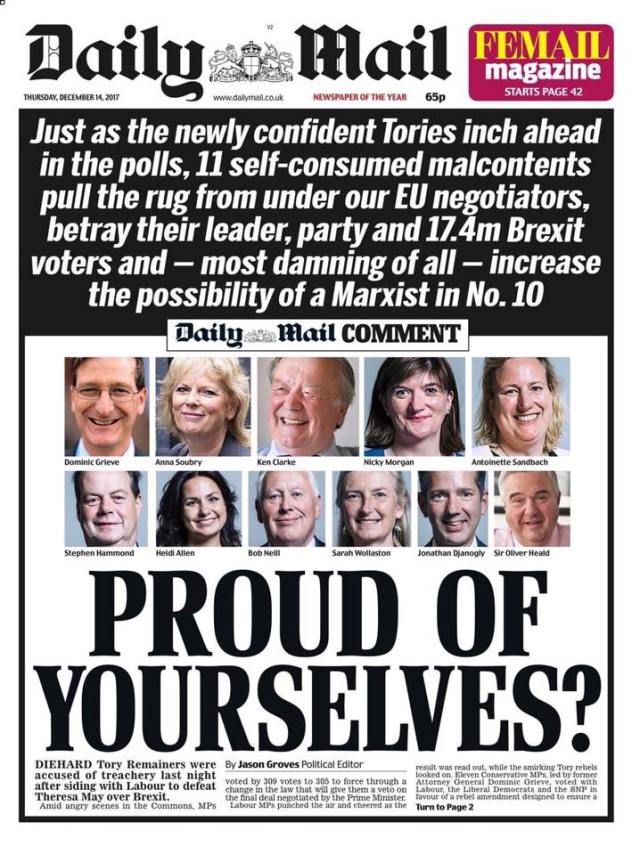
If I’d still been doubtful last June, events since then would have confirmed the wisdom of my eventual decision. The ‘Out’ vote represented only 35% of the British electorate; OK, 52% if you exclude those who didn’t bother to vote, and who of course might well have voted ‘Out’ if they had done; but still a very narrow majority, for such a huge decision. Bearing in mind the disinformation that spewed out from the Brexit side, and the constitutional fact that the referendum wasn’t supposed to be mandatory, there’s good reason to dispute the legitimacy of that. Then there are the huge problems and complications involved in extracting us from the EU, as we’re seeing now, which, even if the decision had been marginally a good one, surely wouldn’t have been thought worth the trouble if they had been revealed sooner; the scarcely-disguised contempt that is pouring on us from the Continent (which I imagine the Brexiteers take as a badge of pride); and the bad feelings back here in Britain that the whole episode has provoked. That embraces the frightening increase in racist and proto-Fascist organisations post-Brexit, and of racially-motivated assaults; the vitriol that has been poured on ‘Remainers’ by the likes of the Daily Mail, which must, surely, reflect the weakness of their position; and, of course, the horrific murder of Jo Cox, MP. Before ‘Brexit’ I had no idea that so many of my compatriots could turn so nasty. If I was reluctant to commit myself exclusively to my British nationality last June, I’m now desperate to escape from it; for, I think, ‘patriotic’, or at least traditional British, reasons. (More on this in my next post.)

So: what can we unreformed ‘Remainers’ do? Our best hope is undoubtedly for a second referendum when the terms of our divorce, and so the reality of the choice ahead of us, are known. The Daily Mail charge that this would be ‘undemocratic’ is clearly nonsense. (See https://bernardjporter.com/2017/09/14/5743/.) In fact it would be our first meaningful vote on the issue. Otherwise the next best option would seem to be as ‘soft’ a Brexit as possible. In any case the wounds created by this whole event will stay with us. A soft Brexit will make the Brexiteers feel betrayed, and so still nastier. A ‘hard’ one will exacerbate the resentment of ‘Europeans’ like me. I can’t see an end to it, myself. But at least I’ll have a bolt-hole, if my Swedish citizenship application goes through.

Posted in Uncategorized | Leave a comment

The Centre Ground

That Theresa May should feel it necessary to use a speech at the Bank of England today to ‘defend capitalism’ is remarkable in the context of the history of the past 30-odd years. It shows how dramatically the political climate in Britain has changed more recently.

In one way it may be thought surprising that it has come so late. The financial crisis of 2007-8 ought, it seemed to many of us, to have turned people against capitalism right then. (Shortly after it, my son bought me a wonderful t-shirt, with a picture of Karl Marx, saying ‘I told you so’.) Instead, of course, it simply turned the capitalist screws even tighter, with ordinary people being made to pay for the banker-induced catastrophe, while the bankers themselves returned to their ill-gotten remuneration – and still dodging their taxes – within a few months. On a more popular front, many people reacted not leftwards, but by turning to the anti-immigrant and sometimes even proto-fascist Right. It’s the impact of all that, together with stories of nurses needing to use foodbanks, rising homelessness, well-publicised corruption in some large businesses, and the Grenfell Tower fire – widely interpreted as the outcome of a market-driven system – that seems to have finally driven the anti-capitalist message home. Plus, of course, the startling rise of Jeremy Corbyn, and his major re-casting of the Labour project, returning it to its socialist roots, which were celebrated so enthusiastically and joyfully in this week’s Labour Party conference in Brighton, ending with an inspirational ‘Leader’s speech’ yesterday afternoon. And, last of these causal factors, there is the egregious mess Theresa May and the Conservative government are currently making of everything. That must be a sign of a certain lack of confidence on the traditional pro-capitalist Right.

All of which would appear to bear out Corbyn’s bold claim in his Brighton speech that the ‘centre ground’ of British politics has now shifted to the Left. This would not be a new phenomenon. Throughout the late nineteenth and twentieth centuries we can see similar seismic shifts in public opinion and the terms of the contemporary political debates. In the 1900s they were turned Leftwards: just look at the newspapers and journals of the time, where ‘socialism’ was debated far more rationally, intelligently and sympathetically than today. That continued during the interwar period and after, where it transmuted into a widespread acceptance, even by the Tory Party, of social democracy and the welfare state. That was the ‘centre ground’ then; until Thatcher came along, determined to erase this, and re-situate the ‘centre’ where she thought (mistakenly) it had stood in Victorian times: unrestrained capitalism overriding all. Remember ‘TINA” – ‘there is no alternative’? We believed it for a while, even some of us on the Left, cowed by the seeming inexorability of the impersonal, material forces that were driving international capitalism, and which lay behind Thatcher, Reagan and then later Blair. (I’m reluctant to give them any personal credit, even for evil. But that’s the Marxist in me.)

The government’s response to the financial crisis – banks unreformed, more privatisation, austerity for the poor innocent proles – seemed to indicate that Thatcher’s capitalist ‘TINA’ could weather all that. And that the juggernaut would lumber on, undiverted, until, probably, finally collapsing under the weight of its own contradictions; just as Marx had predicted, but without the proletarian revolution he had hoped for, and so too late to save the world. (Because climate change is a result of capitalism, too.)

However, if Corbyn is right about the centre’s shifting – and May’s desperation to defend the old capitalist centre may be a symptom of this – we may be in for a pleasant surprise. It will be interesting to read her speech. (As I write, it has still not been delivered.) I imagine it won’t go the whole Thatcherite hog, but will accept the need for pragmatism when it comes to ‘privatisation’, for example; and some restraints on market forces. We’ll see.

Which is, let us be clear, no more than Corbyn is proposing. No-one on the British Left, so far as I’m aware, wants to put everything in the hands of the State. We all recognise the innovative and dynamic role of ‘market forces’, properly regulated. The difference between Labour and more moderate Conservatives is mainly one of degree. Which would return us to the 1950s and ’60s again; which is the ‘centre ground’ that I was brought up on.

Posted in Uncategorized | 5 Comments

The Machine Stops

EM Forster’s early and uncharacteristic novella, The Machine Stops (1909), describes a future community living underground and getting all its wants supplied by a great global machine that feeds them to it – food, communication, entertainment, etc – while they’re sitting comfortably, and getting fatter, in their comfy chairs. The plot begins when the machine suddenly stops working, and the main character – a woman, if I remember rightly – has to clamber up on to the surface to see what’s happening. She finds it inhabited by a sub-race of serfs dedicated to keeping the system going for the benefit of the subterranean privileged elite. (Political bells ringing here!) I can’t now remember how it ends; badly, I think. I do recall that Forster wrote it to counter HG Wells’s more utopian versions of the future.

I thought of this while suffering from the after-effects of my recent burglary (see https://bernardjporter.com/2017/09/20/burgled/), one of which was my being more or less cut off from the internet, and particularly from the site that allows me to blog here. Hence (again) the hiatus; and my non-response to comments. I can’t say I didn’t already know how reliant I was becoming on ‘the Machine’, but this drove it home. It also nearly made me mad; not the disconnection itself, but my (electronic) conversation with WordPress’s ‘Happiness Engineer’ (sic), sitting somewhere in California, I imagine, who was trying to help me put it right. I won’t go through the excruciating twists and turns of this dialogue – they might make you mad too, consisting as they did mainly in circularities (‘I don’t know my password’; ‘to retrieve your password, enter your password’….); suffice it to say that it all seems to be fixed now. (The test will be if this post goes up.)

In the meantime I’ve been living in a kind of limbo, unable to do any useful work, but, worse than that, shocked by how dependent I’ve become on a very clever but still inanimate device. And on the clever young people I need to help me with it. Are they Forster’s surface-dwellers? I must read the book again. It seems extraordinarily far-seeing. But of course this – the 1900s – was the great age of predictive Science-Fi.

Posted in Uncategorized | Leave a comment

Essex Book Intro

INTRODUCTION

I’m an Essex boy through and through. But I’ve always been mildly embarrassed by that. Essex has never been a highly-regarded or ‘proud’ county, even before the emergence of ‘Essex Man’ (vulgar) and ‘Essex Girl’ (promiscuous) to sully its reputation in the 1980s. It was a non-county, with no special identity or pride compared with others like (especially) Yorkshire, where I live now. I realised this when I went up to university, meeting and envying people from much more attractive counties or cities than Essex; and particularly than London-suburban Essex, which Hornchurch was then. (It’s now part of Greater London.) This hybrid identity posed problems. Asked where I came from, I was in two minds whether to reply ‘Essex’, which sounded dull, or ‘East London’, which was more interesting, and which I would have preferred, as a bit of an inverted snob, but which implied eel pies and whelks, which wasn’t Hornchurch at all. (Simple ‘Hornchurch’ would have drawn a blank.) Besides, I knew the ‘proper’ or rural Essex far better, spending most of my summer holidays as a boy cycling over it, photographing and sketching churches and other historic buildings, following Essex County Cricket Club around, and visiting my father’s family in Chelmsford.

One of Essex’s problems is its place on the map. It’s quite a large county, as it happens – tenth out of 39 of the ‘historic’ counties; but lying under the great East Anglian bulge which is Norfolk and Suffolk, stretching down to the mudflats of the Thames river and estuary, and broken up more and more as you go south by further muddy estuaries and seeming nothingness. It sort of peters out to the east, boringly if you don’t like sea birds, sky-scapes or sailing, with no firm defining boundary around it. On the map of England it looks a bit like an armpit. To the south-west, of course, it has been extensively encroached upon by the ‘Great Wen’ of London, which has significantly changed the county’s character today; and all over by the ‘stockbroker belt’, on the lines to Liverpool Street (convenient for ‘The City’), taking over and converting many of the picturesque older houses, which has made it virtually unaffordable to live in for locals. You won’t find many Essex accents in the county today; only London (‘cockney’), ‘Estuary English’, and tight-arsed upper-class. For the sort of ‘Essex’ my father and grandparents used to speak – warm, rural, richly musical – you now have to venture into Suffolk or Cambridgeshire. Of course that’s a source of regret for nostalgic oldies like me.

But that’s ‘progress’, as they say. Nostalgia has its tearful pleasures, especially later in life, remembering (in my case) the bike rides, the leafy lanes, the quiet towns, the lovely little churches, the solitude, sitting in cornfields sketching and painting, resisting the advances of the cycling paedophiles (oh yes, we had them then), and those fun nights at the Youth Hostels (no cars allowed), crippled with cramp after a hundred miles a day of peddling. I’ve always resisted nostalgia; but I guess that, at my advanced age, it can’t do me much harm now. And I can put it in its place. Of course things have to change. And in the case of Essex, the changes of the past seventy-odd years have – in my view – added to the richness and certainly the fascination of the county; even the much-derided arrival, from the slums of East London, of Essex Man and Essex Girl.

Imagine what it would be like now without them. Actually I don’t need to imagine, living as I do presently in the East Riding of Yorkshire – or North Humberside, if you want to be up-to-date – which is similar to Essex in many ways, especially its landscape and wonderful old churches, but without Hull, on its southern border, being able to infuse it with the new blood and liveliness that the East End of London imparts to Barking, Brentwood, Billericay and all places north-east. The East Riding really is dull – and comfortable. (I love living here.) OK, it doesn’t have the clogged-up roads and railways, the (very) nouveaux riches in their pretentious ‘stockbroker Tudor’ homes, the concentration of ugly petrol stations, McDonald’s eateries, and snobby golf courses that blight the ‘home’ counties, all of which is to the good; and it is undoubtedly just as pretty as Essex. (Ask David Hockney.) But where are the life and vitality that you find in Essex, only partially compromised by their less salubrious sides: the Jamie Olivers, Bobby Moores, Graham Gooches, Russell Brands, Maggie Smiths, Grayson Perrys, Sandie Shaws, and (I’m afraid), David Irvings: to name but a few, most of them from the London side of the county. And where in the East Riding is the political radicalism that has been a great feature of Essex historically, deriving to a great extent from its proximity to the filthy metropolis next door? Or the New Town architecture – those great experiments in social living? And what can compare with the peculiarly attractive, semi-rural quality of Essex cricket?

What I hope to do in this book is to make out a case for Essex’s being at least interesting. I’m aware that I don’t have all the proper credentials for this task, not being what is called a ‘local’ historian; though I did write a book about Essex, illustrated, at the age of about fourteen, now lost (my mother kept none of my juvenilia), but, as I remember, mainly plagiarised from other books, which is how I thought history was written at that age. (Some of the students I later taught at university seemed not to have moved on from there.) My professional expertise is in more nation- and indeed world-wide history, plus a little foray into the history of architectural theory; but as I’ve found in my own writing in the past, an outsider’s perspective can often inform the most specialist of disciplines, so long as one is prepared to learn, respectfully, from the specialists’ work, and retains one’s own scholarly – that is, sceptical – discipline. Besides, I may be better placed than more parochial historians to properly appreciate and describe the place that my county and its inhabitants have played in Britain’s broader national history. As a non-specialist I feel fortunate that Essex, despite its low esteem, offers a plentiful specialist literature for me to plunder: stretching from the huge multi-volume Victoria County History of Essex, edited for a time by WR Powell, whom it so happens I knew as a boy when he attended the same Methodist church that my father and I did in Harold Wood; through to gazetteers, guide-books, archaeological reports, popular publications of the Essex Record Office, an early ‘Pevsner’, romantic travel-books, and even a novel or two. These, and my memories, especially as a boy brought up at the very meeting point between the two cultures whose intermingling has contributed so much to present-day Essex, are my sources. On top of that will be spread a layer of I hope intelligent speculation, which should be easily distinguishable from the ‘facts’, and so easy to discount, if it’s considered untrustworthy.

This book will not be the first to try to rescue Essex’s reputation. Many authors have written in ‘praise’ of Essex, albeit struggling against what they represent as almost impossible odds. If Essex hasn’t got a unique reputation for awfulness, it is certainly thought to have one by those several writers who have sought to defend it. ‘It’s arguably the most-maligned 1,300 square miles in the UK’, claimed a BBC documentary in 2010, before going on to give its own contrary view. ‘Yes, everyone knows about Essex’s reputation,’ writes another. ‘People from Essex in particular are well aware of that reputation, thanks to the knowing looks and smirks we frequently get when we confess our roots. In order to avoid this, less hardy locals will respond to the innocent enquiry with ambiguous statements like “near London” or “in the South East.”’ That’s my experience precisely. Its reputation as ‘flat and uninteresting’ goes back at least a couple of hundred years. No wonder then that, as the very first issue of the Essex Review put it as long ago as 1892, ‘it has often been said that there is less county pride in Essex than probably any other British county’. More recently – and partly because of the influence of ‘Essex Man’ and ‘Essex Girl’ – it has been described as ‘the dustbin of London’, ‘the golden turd of England’ (!), and plenty more in the same style. That’s what its defenders claim; which makes their task of rehabilitating the wretched place, of course, all the more heroic. I salute them.

The present book, however, won’t exactly fit into that pattern. I don’t see it as an ‘in praise of’ kind of book. It certainly isn’t intended to engender pride in Essexites’ Essexness – ‘Essexite’, incidentally, is a neologism, there being no other collective noun to describe the county’s inhabitants – as I don’t believe in the logic of any people’s feeling ‘pride’ in the mere accident of their birth. Besides, Yorkshire folk have enough of that for all of us. (They can keep it.) It won’t, I promise you, be too nostalgic, starry-eyed or honeysuckle-scented – though the smell of honeysuckle on balmy summer days is, as it happens, one of the things I recall most fondly about my cycle rides in the Essex countryside. Needless to say, the book won’t pretend to be comprehensive, or a ‘last word’. It will have worked, if it stimulates some interest in, and maybe a little affection for, an unjustly neglected corner of England.

It will begin with some very early prehistory, before cantering through the recorded history of the county, at quite a lick. The subsequent chapters will explore various ‘themes’ arising from all this, and some theories. You’ll see.

Posted in Uncategorized | 9 Comments