Elective Dictatorship

I’m still astonished by the revelation that the American Constitution gives so much unchecked power (as it seems at present) to a single person. George III had nothing like the same authority; and some of his royal predecessors met gruesome fates when they tried to assume it, over the heads of Parliament.

It is even more surprising when we learn, as we are expecting to do later today, that this power extends over foreign countries too. (We’re still waiting for his announcement on tariffs.) Again, that would be unthinkable in most other ‘democracies’. It’s no wonder that Trump’s closest soul-mates today are Putin and Netanyahu; who must feel that they’ve been given carte blanche to pursue any policy they choose.

I would like to feel a constitutional revolution coming on. Or a civil war (17th-century English style). But probably not.

Posted in Uncategorized | 2 Comments

The Art of the Deal

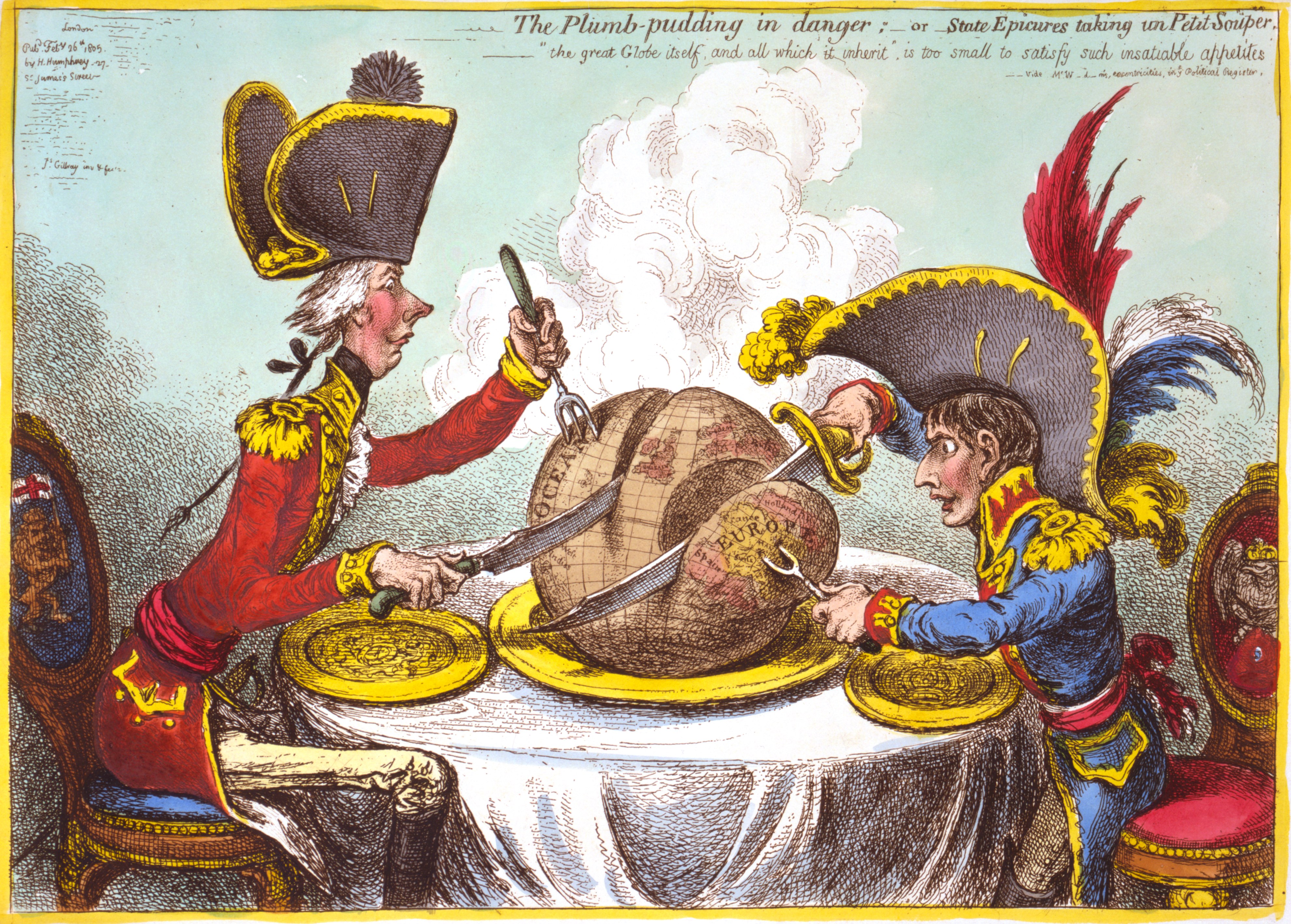
Easy, isn’t it? – USA gets Greenland, Russia gets Ukraine, China gets Taiwan. All neat and tidy. Everyone agrees. No more wars. Back to the 1790s: https://bernardjporter.com/wp-content/uploads/2025/03/caricature_gillray_plumpudding.jpg.

(See https://www.theguardian.com/world/2025/mar/28/putins-endorsement-of-trumps-greenland-takeover-reflects-their-vision-of-a-new-world-order.)

Posted in Uncategorized | 1 Comment

Trump and Universities

For academics a crucial aspect of ‘Fascism’ is the way it plays out in universities. As a retired academic I’ve been shocked by some of the reports coming from America over the past month featuring censorship of free speech in colleges, not by radical Left no-platformers (although they disturb me too), but by the Federal or State authorities, and ordered by Trump. Here’s one recent example: de-funding programmes which teach ‘improper ideologies’, including portraying America’s ‘founding fathers’ in a less than heroic light:

https://www.clickondetroit.com/news/politics/2025/03/27/trump-executive-order-on-smithsonian-targets-funding-to-programs-with-improper-ideology/?__vfz=medium%3Dconversations_top_pages.

‘Improper ideologies’! Doesn’t that have a whiff of ‘1984’ about it? Or of the old Soviet Union? For the State (in the person of the President) to be ordering professors what and – more importantly – what not to teach surely goes right against the independence and intellectual freedom that are usually associated with and valued by institutions of higher education; or were in my time, at least. Questioning the motives of the ‘founding fathers’ might undermine a certain sort of ‘patriotism’, which I imagine is what is troubling the MAGA lot; but ‘patriotism’ is emphatically not what universities are there to teach.

There are many more indications of this kind of US government hostility towards universities, and even, one suspects, towards intellectual enquiry itself. Courses have been suddenly de-funded; foreign graduate students forcibly (and illegally) flown out of the country (or in one case down to Louisiana) for demonstrating peacefully against America’s support for Israel in Gaza… and so on. Other examples are featured here: https://www.theguardian.com/commentisfree/2025/mar/29/trump-ice-deportation-universities. Or you can simply Google ‘Columbia’. – If you don’t think that ‘Fascism’ quite fits the bill here, then ‘dictatorship’ or ‘authoritarianism’ should cover it. In any case it’s scary.

I’d hate to be teaching at Yale again now. Clearly I’m not alone. At least three current Yale Faculty are fleeing over the northern border to find academic freedom there: https://edition.cnn.com/2025/03/28/us/yale-university-scholars-toronto-trump/index.html. Presumably the USA’s loss here will be Canada’s gain. Or – more likely – Trump won’t care. After all, what do ‘intellectuals’ know about the ‘Art of the Deal’?

Posted in Uncategorized | Leave a comment

The Great Reaction

Ages ago I considered the idea of researching and writing a history of the political ‘Right’ in Britain, following on from my works on ‘imperialism’ and its enemies. I’ve still got notes on this, in a file somewhere back in the UK; but they never came to anything. One of my reasons for abandoning the project was that by then – the 1970s – most people assumed that Right-wing ideas had lost their contemporary relevance, in the face of the social democratic tide that had engulfed Britain and most of continental Europe, and appeared to be the most likely path to be followed – soon, we hoped – by the rest of the world. The Right had come to be widely mocked and satirised, as old-fashioned, stupid, invalidated, nasty, or even simply ‘silly’; so that any research I might do into it would be merely historical, and of little or no relevance to the (then) present day. Rightists were dinosaurs; still surviving in one or two places (Peterhouse Cambridge was one; Enoch Powell’s West Midlands another), but with no future ahead of them, in the bright liberal-progressive climate that had emerged from the War. Researching the Right might be interesting – I personally have always been fascinated by the genus; but of no practical use or interest to anyone.

I’m not sure that I completely shared this assumption – I’ve always been reluctant to risk predictions based on history; but to the extent that I did, the 1980s soon disabused me. In Britain, the Right came storming back with Thatcher; in America I guess with Reagan; and within a few years ‘reaction’, as we Leftists saw it, became the new ‘progressive’ trend of the time. It even spread to the Soviet Union, the lodestar for (some) Leftists ever since 1917; whose counter-revolution in and after 1989 left Russia as economically reactionary (i.e. capitalist) as any country, and rather more totalitarian than most. Political liberalism, as we understood it, was in retreat.

Recent events in the USA – the ‘shining city on the hill’ for many liberals in the past – have compounded this. We’re all aware of the rapid lurch to the Right that America took immediately after Donald Trump began his second Presidency in January this year, and which is continuing helter-skelter as I write. ‘Fascist’ used to be a word only used by the far Left to describe this, and dismissed as paranoia by reasonable folk; but now it’s a common way of characterising Trump and his approach to government. Political preferment is restricted to those who are loyal to the ‘leader’; crude nationalism is favoured over internationalism (‘Make America Great’); immigrants are subjected to mass deportations; foreign students expelled for supporting the Palestinians (Netanyahu, another wannabe dictator, must have had a hand in this); books are banned; universities are bullied into conformity; liberal (‘woke’) ideas are mocked and even censored; truth is blatantly distorted (‘alternative facts’); government (‘bureaucracy’) is cauterized; racism and toxic masculinity celebrated; anti-intellectualism encouraged; violence, in the ‘right cause’, tolerated or celebrated; public protest for other causes criminalised; billionaire oligarchs brought into government; imperialistic projects openly floated (Greenland, Gaza, Panama, Canada); – and all this done by mere executive fiat – ‘dictat’ may be a better word for it – in clear contravention of America’s much vaunted Constitution, and in particular its ‘separation of powers’: the ‘checks and balances’ that were supposed to keep the Executive branch (the President) in check. This America isn’t any longer the one whose history I studied at university in the sixties, and experienced first-hand when I lived there; which of course had many flaws (as every nation does), but none of them so ‘Fascistic’ as those that Trump is bestowing on it today.

Of course America, in common with everywhere else, has always harboured the seeds of Fascism. There was an overt Nazi movement there in the thirties, for example; and then there were slavery, segregation, lynching, eugenics, genocide, McCarthyism, and of course the glorification of violence in ‘Western’ movies, and guns. You can see a fascist potential there, clearly, a historical back-story; but it’s Trump who is now bringing that to fruition. The process is not yet completed, and might never be, if the Democrats, perhaps, or even old-fashioned decent Republicans, can grow some cojones. (Is there much popular resistance to Trump in the USA? From where I’m based – Sweden, presently – it’s difficult to see any; but that may be because of the width of the Atlantic, and the noise and confusion created by the MAGA mob.)

Clearly this situation doesn’t only affect America, but the rest of the world too. For a start it must encourage Rightist and dictatorial movements everywhere, including in Europe and the Middle East, where authoritarian, illiberal and reactionary movements have in any case been growing recently, and now have America’s example to encourage them. Trump has admirers in Britain, where Nigel Farage is one of his leading fans. The Right is now confidently surfing this new historical tide, leaving Left-‘progressive’ forces uncertain how to counter it; especially now that it’s allied to what is called ‘populism’, which makes it appear more ‘democratic’.

But there are diplomatic and geopolitical aspects to it as well. America used to be regarded, and to regard herself, as the guarantor of democratic and liberal values throughout the world, either unilaterally or via NATO and other international agencies. Now that guarantee has lapsed. Trump wants to abandon NATO. As a result Western Europe can no longer depend on the USA to defend her against – presently – Russian expansionism; which is why Britain and other democracies are rapidly re-arming: to be able to defend Ukraine initially (and after that, Finland and the Baltic States?); and also why Ukraine’s own situation now looks so fragile. For America is no longer basing her foreign policy on principle – ‘freedom’ (however you define it); but on Realpolitik: the politics and morality in this case of the property developer, which is all that Trump was and essentially still is; based on the ‘deals’ you can make with the ‘cards’ in your hand, and nothing more principled. This is what happens when you elect a real estate capitalist to be in charge of things.

The global event that took ‘principle’ out of the equation for American leaders was of course the fall of communism in Russia and eastern Europe; which back in the ‘Cold War’ years had been considered – not unreasonably – to be an ideological and domestic threat to the West, as well as a military one. It was also one that could spread, infecting and engulfing other nations – and even America herself – if not staunched. That was what incentivised all post-war American Presidents to employ their military power, in America’s own interests, to defend other ‘free’ countries as well as their own. When the communist threat collapsed, it left America and Russia with nothing ideological to separate them, with both sides now playing on the same realpolitikal pitch. It is this that has brought Trump and Putin together, with the former admitting to admiring the latter more than he could have done in communist times, as someone he could ‘deal’ with, to use his favourite property-developer’s word. Hence his betrayal of Ukraine, which is simply a pawn (or a bit-player) in his game; and also of the Palestinians in Gaza, whom he sees not only as ‘losers’, with Israel holding all the ‘cards’, and so not worth rescuing; but even as a winner for him personally, if he can turn it into another prime development for rich Americans. (You’ve seen the video: https://bernardjporter.com/2025/02/26/satire/.)

Where does all this leave Europe: now flanked by two autocracies (or at least one and a half), in place of the autocracy to the east and the friend to the west: the pattern that had dominated the European diplomatic map for half a century? With American leaders like JD Vance and Pete Hegseth now expressing their disdain for and even ‘hatred’ of Europe, supposedly because of the latter’s ‘wokeishness’ and ‘pathetic free-loading’ off the USA (https://www.politico.eu/article/freeloader-john-healey-pete-hegseth-europe-uk-defense/), it is clear that we (here in Europe) can no longer trust America to come to our aid if Russia – or any other power – threatens; which is of course why we are hastily building up our own military capacity. More generally, liberal and social democracy as most of us in Europe understand it, together with Canada and many (not all) of Britain’s other ex-colonies (why I wonder are they so much less Trumpian than the ones that gained their freedom in 1783?), are now under threat from both sides – both of them autocracies if Trump gets his way. That adds an ideological and cultural element to the picture.

In 1992 the Chicago political scientist Francis Fukuyama published a famous book, The End of History and the Last Man, which people took as predicting that  present-day liberal capitalism was the last stage or climax of human progress; leading to a kind of stable utopia, with no more ‘historical’ development to follow. So far that theory has not worn well, and in particular the ‘liberal’ part of it. Capitalism does indeed seem to be progressing strongly; but now in highly illiberal clothes. It has become – in both America and Russia, and also in China, which may soon overtake them both – almost the opposite of ‘liberal’ in that word’s political and social (as distinct from economic) sense; obeying another once oft-touted theory of historical progress, which saw it in neo-Darwinian terms: natural selection; survival of the fittest, or strongest, or in the present context the richest and the most techno-savvy; with ‘moral’ (human, ethical, social) considerations of little account. That may be our future.

Unless, that is, American true democracy can get its act together. Until then it’s Europe (and its ex-colonial offshoots) on whom we must rely to keep social-liberalism – or ‘genuine’ democracy – alive. No wonder that it’s there that Trump, Vance and the world-wide Right are presently training their rhetorical guns.

*

(Obviously I shouldn’t have abandoned my ‘history of the Right’ project when I did. But then others have taken it up.)

Posted in Uncategorized | 1 Comment

‘Adolescence’

You must see this four-part British TV series, recently released on Netflix, and starring Stephen Graham, whose craggy face will be familiar to you; and a new boy actor, Owen Cooper. Both are transcendingly good, and the film a great example of the grittily realistic sort of work we usually associate with Ken Loach (but without the laughs). It is also very timely, with the harm done by present-day internet ‘influencers’ like Andrew Tate obliquely but obviously targeted. I binged on it last night, and was left emotionally drained.

It also got me thinking more about ‘toxic masculinity’. I’ve only recently become aware of this, and never felt it could be useful to my work – it’s more relevant to Kajsa’s, on ‘gender’. But maybe I should take more account of it when writing about ‘imperialism’; which clearly had – and has, in Donald Trump’s case – more than a hint of ‘toxic masculinity’ about it.

Posted in Uncategorized | 1 Comment

The War on Academia (US)

A great piece by Meghan O’Rourke here:  https://www.nytimes.com/2025/03/16/opinion/university-defunding-trump-rufo.html.

If you can get this up – I could only do it by subscribing to the New York Times – it paints an alarming picture, by a Yale professor, of what appears to be a sudden but long-gestated assault on US universities and their values by Trump and his gang. (American readers: is she right?) As an ex-academic myself – briefly at Yale as it happens – it struck me personally. But it should also be alarming to anyone else who values academic liberty and ‘free speech’, as Rightists profess to; including in Britain, where we can see signs – albeit lesser ones – of the same anti-academic prejudices in our own politics; as well as some of the same silly provocations – ‘non-platforming’ and the like – in our colleges.

(If you can’t access the article from this link, and don’t want to subscribe to the NYT – which however is pretty cheap, and of course well worth getting in any case – you should be able to find it elsewhere.)

Posted in Uncategorized | 1 Comment

Mad Scientists in Fiction and Fact

The ‘Mad Scientist’ has been a common trope in fiction – novels, movies, comic books – ever since Mary Shelley’s Dr Frankenstein, and possibly before. (There’s an incomplete list of them here: https://fearplanet.net/2024/07/17/top-20-mad-scientists-in-fiction-and-film). My favourite one as a kid was the Mekon, from the Dan Dare comic strip in the Eagle, whom I’ve mentioned – and pictured – before (https://bernardjporter.com/2020/02/13/journey-to-mekonta/). They came in a variety of shapes and sizes – some, like the Mekon, weren’t even human; but they all shared one common feature, which was their cold rationality, and consequently their lack of human empathy. This was their most evil attribute, and the most difficult one for decent heroes like Dan (British public school-educated, of course) to counter, without sacrificing their own humanity. The post-World War II ones were generally based on Nazi doctors and scientists; or even on Hitler himself.

Which is why my mind immediately turned to them when I read this statement by the Nazi-saluting Elon Musk: that ‘the fundamental weakness of Western civilization’ – no less – ‘is empathy.’ (For context, see https://www.snopes.com/fact-check/elon-musk-empathy-quote/.) – Now, Musk may not be much of a ‘scientist’, if what I read about him is true; and his exploding spaceships don’t give one much confidence here. But he surely satisfies the ‘mad’ bit of that appellation. He’s also, we’re told, inordinately rich, and owns much of the ‘social media’; which are what make his ‘mad’ views particularly dangerous. In short, he seems to be the evil (query-) scientist and capitalist de nos jours. He’ll surely figure in a Marvel comic, on the side of the ‘baddies’, before very long.

In short: a monster.

Posted in Uncategorized | Leave a comment

Spheres of Influence

Is this what America and Russia want – to carve up the world between them? (A famous Gillray cartoon.) Replace Pitt and Napoleon by Trump and Putin, and of course slice the pudding differently; and it could serve for today.

Posted in Uncategorized | Leave a comment

Manifest Destiny

I’m a little surprised at Trump’s recently expressed expansionist ambitions – Greenland, Canada, Panama, his Gaza seafront condos – as I had always had him marked down as an isolationist, following in that well-trodden American tradition. But the US has always – from its very birth – had a solid imperialist tradition too; which of course I’m aware of, to the extent of having written half a book about it a few years ago. That was in order to demolish the common American assumption that – as Donald Rumsfeld memorably put it in 2006 – ‘we don’t do empire’; which I imagine was inferred from the fact that the USA was originally born of an anti-imperial rebellion, and so must have been innocent in this regard ever since. In fact Rumsfeld was egregiously wrong about this, in ways I explain in that book (Empire and Superempire, Yale UP, 2006), and in ways that most modern American historians will confirm. (I wasn’t by any means the first to come to that conclusion.)

So, Trump’s expansionist ambitions should come as no surprise. Indeed, some of them are revivals of older colonial projects, such as his Panama scheme, which would see the US return to a colony it only abandoned (sort of) in the 1980s; and Canada, which it tried – but failed – to annex in 1812. Before that there was the seizure of much of Mexico and of all of the previously French territory in the South to look back on, as well as Hawaii, Alaska, and the ‘Wild West’ of the north American continent – stolen of course from the native Americans. Greenland might be a new imperial target today, as the ‘purchase’ of Gaza as an ethnically-cleansed piece of luxury real estate certainly is. But territorial expansion has always been an essential part of the greater American project; sometimes – at the turn of the 20th century in particular – called imperialism, but even when it wasn’t.

The reason why most Americans were reluctant to recognise this as ‘imperialism’ – apart from the word’s association with mad King George III – is that America’s ‘colonies’ were not, and presumably won’t be under Trump, ruled in the traditional European way, with ‘viceroys’ in silly plumed hats and district commissioners in khaki shorts and pith helmets; but more indirectly, through local and American commercial collaborators doing the USA’s will. (This was a favourite British method too, but supplemented here by the plumed hats where necessary.) So American ‘informal’ colonies didn’t carry the visible signifiers that were generally associated with ‘imperialism’; thus allowing the USA to cling to its anti-imperial reputation for all those years.

One thing America shared with other imperial powers, however, was a certain arrogance: a tremendous self-belief that she represented the summit of civilisation, just as the ancient Romans, British imperialists, the Spanish conquistadores, German Nazis and Russian international communists had, in every case justifying their control or influence over other peoples. We can see this in Trump, of course; it’s one of the things that in his view will render Greenlanders, Canadians and Gazans eager to welcome their new status as the 51st to the 53rd States of America eventually. That of course would also draw some of the alleged ‘imperial’ sting. The US’s superiority is supposed to lie in its ‘freedom’, defined commercially, and its prosperity; which are the prizes Trump is offering to Canada, Greenland and Gaza, but entirely oblivious of the possibility that these goodies might not be what the populations of these places really want. America holds all the ‘cards’, as he told Zelenskij last week; other places (‘shithole countries’, as he once characterised some of them) must envy her. There’s the mind of the property-developer capitalist talking. The ‘Art of the Deal’ is as simple and materialistic as that.

It’s this that could be said to bring the two great traditions of American foreign policy together. Trump is an isolationist first and foremost: ‘America First’, and all that. But his other big slogan – ‘Make America Great Again’ – implies competition with other countries; colonising many of them in effect, in America’s commercial interests, but not understanding them at all. His is a sort ofisolationist imperialismwhich has the advantage of being cheap – indeed profitable – but with none of the advantages that the older-fashioned European plumed-hatted sort of imperialism had. When you run ‘alien’ colonies more directly, and out of a sense of ‘service’, not just for profit, you get to know about their alien ways, and often to empathise with them. (I realise that this is an unfashionable idea; but you’ll find it elaborated in my ‘British Empire’ books. Two great novels, EM Forster’s Passage to India and Graham Greene’s The Quiet American, also bear on it.) Hands-off rule doesn’t have this advantage.

Trump’s approach also seems to me to bear out Lenin’s famous characterisation of ‘imperialism’ as being ‘the last stage of capitalism’. What could be more last-stage capitalist than a property developer and a fabulously rich techno-entrepreneur looking around for more real estate to annex?

Posted in Uncategorized | Leave a comment

‘Christianity’ Weaponised

I was brought up a Christian, in a very liberal (English Methodist) church. I was happy there, and only left when it was demanded of me that I have ‘faith’: ‘Faith, Hope and Charity’, as it says in the Good Book (I Cor 13. 1-13). OK, ‘Charity’: that goes without saying. ‘Hope’: well, if you’re lucky. But ‘Faith’ – that is, uncritical faith, in the existence of a God, for example, or the Resurrection – I felt went against my vocation as a budding scholar. So I dumped it. What I’ve retained from my Christian upbringing is the moral teaching, as I understand it, of most of the New Testament, especially the four Gospels (but not 1 Corinthians); and which is found, of course, in other religions too.

Which is why I’m still unwilling to identify as a Christian, when that might associate me with others, like Jacob Rees-Mogg and people on the American ‘Christian’ Right, whose views directly contradict the true kernel of Jesus’s teaching . Again, ‘as I understand it’. (I’m no theologian; but then Jesus wasn’t preaching to them.)

Many others have made the same point about false, tribalised and weaponised versions of ‘Christianity’. Here’s one recent example: https://medium.com/@garylellis/when-christianity-lost-christ-e5d388da5d58. – Monty Python’s Life of Brian is pretty sound on this, too:

Brian: Look, you’ve got it all wrong! You don’t need to follow me. You don’t need to follow anybody! You’ve got to think for yourselves!  You’re all individuals!
Crowd:  Yes! We’re all individuals!
Brian: You’re all different!
Crowd: Yes, we are all different!
Man in crowd: I’m not…
Crowd: Shh
h….

Brilliant!

Posted in Uncategorized | 2 Comments